


WASHINGTON — SpaceX filed documents for an initial public offering of stock May 20, revealing the company’s finances and enormous ambitions.
The company filed its S-1 registration statement with the U.S. Securities and Exchange Commission after the markets closed. That document is a step towards one of the most anticipated IPOs in recent memory, expected to take place on the Nasdaq exchange by mid-June.
The S-1 form did not include details such as the number of shares the company plans to sell or pricing, details that are frequently excluded in the initial filing of the document and updated closer to the IPO. SpaceX is seeking to raise up to $80 billion at a valuation of around $2 trillion, according to numerous reports.
The document, though, does provide financial details that the privately held company has not disclosed previously. The company reported in 2025 revenue of $18.7 billion and adjusted EBITDA of $6.6 billion, while in the first quarter of 2026 SpaceX recorded $4.7 billion in revenue and adjusted EBITDA of $1.1 billion.
SpaceX splits its financial results into three business segments: space, connectivity and AI. The space segment, which includes launch and related activities, like its Dragon spacecraft, recorded revenue of $4.1 billion in 2025 and $619 million in the first quarter of 2026, with adjusted positive EBITDA of $653 million in 2025 and adjusted negative EBITDA of $351 million in the first quarter of 2026.
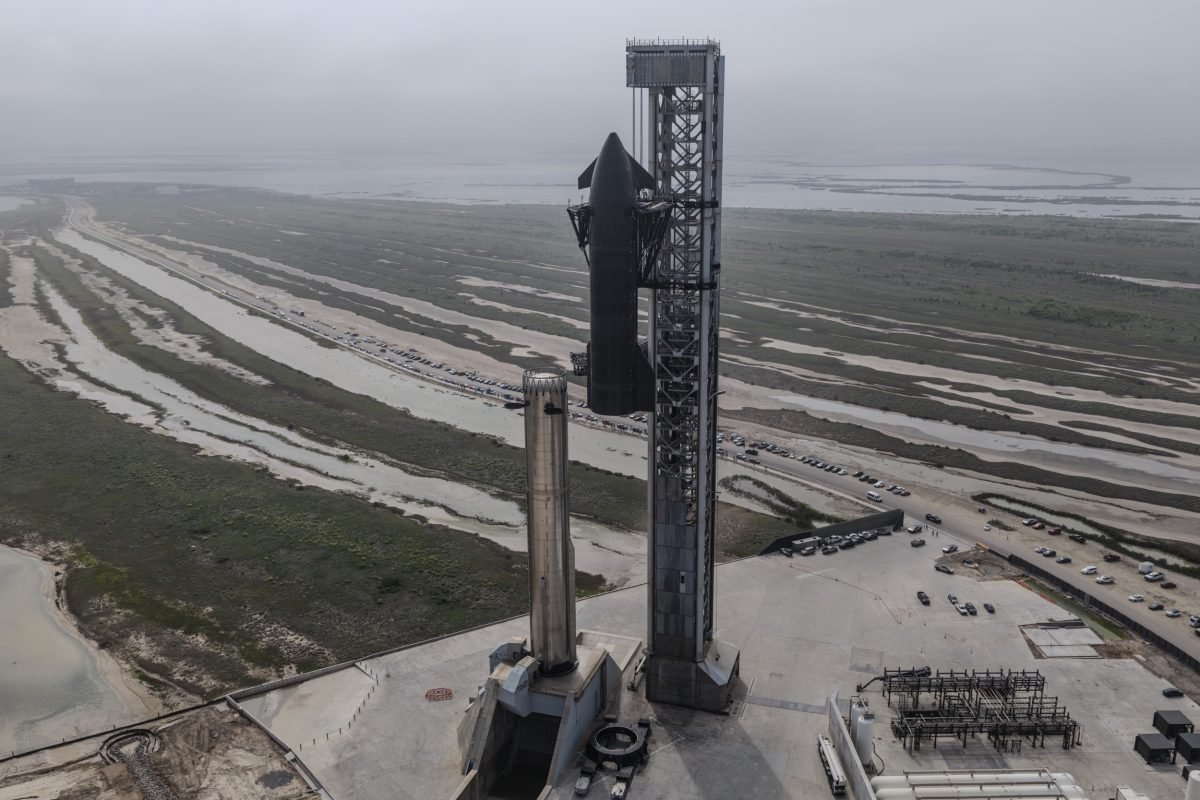
The document shows the high levels of investment the company is making into its Starship vehicle. The company recorded spending $3 billion on Starship development in 2025 and $930 million in the first quarter of 2026. SpaceX said it expects Starship, which is scheduled to perform its 12th suborbital test flight as soon as May 21, to start launching satellites in the second half of the year.
The connectivity segment covers SpaceX’s Starlink services, and accounts for the majority of the company’s revenue and earnings. It accounted for $11.4 billion in revenue in 2025 and $3.3 billion in the first quarter of 2026, with adjusted EBITDA of $7.2 billion in 2025 and $2.1 billion in the first quarter of 2026. SpaceX said it had 10.3 million Starlink subscribers as of the end of the first quarter of 2026, compared to 5.0 million a year ago.
The AI segment was created from SpaceX’s acquisition of xAI in February. It provided $3.2 billion in revenue in 2025 and $818 million in the first quarter of 2026, with adjusted EBITDA losses of $1.2 billion in 2025 and $609 million in the first quarter of 2026.
Notably, SpaceX spends far more on research and development in its AI segment than in either space or connectivity: $12.7 billion in 2025 and $7.7 billion in the first quarter of 2026.
SpaceX justifies the high spending on research and development on the market opportunities it is pursuing. “We believe we have identified the largest actionable total addressable market (TAM) in human history,” the company stated, with a total addressable market of $28.5 trillion. That includes $370 billion for its space segment, $1.6 trillion in connectivity and $26.5 trillion in AI, primarily in enterprise applications.
Those AI opportunities would be enabled, in large part, by SpaceX’s plans for orbital data centers. The company stated in the document it plans to start launch orbital data center spacecraft as soon as 2028, but acknowledged that “significant work remains.”
“We believe SpaceX is uniquely positioned to deploy and operate data centers in orbit that can eventually achieve a lower cost than terrestrial data centers over time due to our extreme vertically integrated approach across launch, satellite manufacturing at scale, network connectivity, and terrestrial data center expertise,” the company stated.
“We believe that our current space efforts will catalyze transformative breakthroughs that could reshape terrestrial industries and lead to the emergence of new trillion-dollar markets on the Moon, Mars, and beyond,” the company added. Those markets could include point-to-point travel, space tourism, in-orbit manufacturing, manufacturing and energy production on the moon and Mars, and asteroid mining.
“We believe we have a distinct ability to identify, develop, and commercialize new multi-trillion-dollar markets that did not previously exist,” SpaceX stated in the filing, “:We currently stand alone in our ability to deliver revolutionary breakthroughs across spaceflight and exploration, global connectivity, and artificial intelligence, enabling an age of abundance that we believe has the potential to propel an unprecedented expansion in the global economy.”
