


3D printer manufacturer Stratasys has expanded its product lineup with a new PolyJet printer, new software tools for GrabCAD, a new medical silicone for Origin systems, and a new PA12 powder for SAF production. Announced together, the updates target functional prototyping, patient-specific medical devices, automated tooling design, and industrial powder bed manufacturing.
At the hardware level, Stratasys introduced the J850 Core, a PolyJet printer aimed at engineering teams focused on functional prototyping rather than full-color output. The machine gives users access to PolyJet materials and performance without paying for color capability. Stratasys said the platform is suited for enclosures, housings, jigs, fixtures, and other functional components. Supported materials include rigid, flexible, transparent, and PolyJet ToughONE options. A large build tray and high-speed print modes are intended to support faster iteration and repeatable results. Booking for the system is scheduled to open by the end of April. “Manufacturers are seeking more applications for additive manufacturing, and that’s exactly what these innovations are designed to provide,” said Rich Garrity, President and Chief Business Unit Officer at Stratasys. Garrity added that the J850 Core is designed for engineering teams that need to validate parts quickly on a daily basis.
Healthcare formed another part of the announcement. Stratasys and Shin-Etsu, a Japanese chemical company, introduced P3 MED Silicone 25A, which the two companies describe as the first biocompatible true silicone for 3D printing patient-specific medical devices and low-volume production parts. Available exclusively on Origin printers, the material is certified to ISO 10993 standards. Stratasys said it is designed to deliver silicone properties, including elasticity, durability, and resistance to heat, chemicals, and aging, addressing challenges traditionally associated with 3D printing true silicone. The material is intended for applications such as hearing aids, CPAP masks, orthotics, and prosthetics, while reducing reliance on molds and tooling. “P3 MED Silicone 25A opens new possibilities for patient-specific devices and low-volume medical production,” said Erez Ben Zvi, Vice President of Healthcare at Stratasys.
Software was the third part of the release. GrabCAD, Stratasys’ software platform for additive manufacturing workflows, is set to receive a new Additive App Suite developed with trinckle, a design automation software company. Stratasys expects the suite to launch later this summer with 10 apps, with 15 planned by Formnext 2026 in November. Applications for clamping jaws, shadow boards, and drill guides were available for demonstration at RAPID + TCT 2026. Embedded into GrabCAD Print and GrabCAD Print Pro, the tools are intended to let manufacturing engineers generate production tooling within a single workflow rather than rely on separate custom design steps. Stratasys said flexible licensing will be available for both individual and enterprise users. “The Additive App Suite allows teams to go from a production problem to a print-ready solution in minutes, not days,” said Victor Gerdes, Vice President of Software at Stratasys.

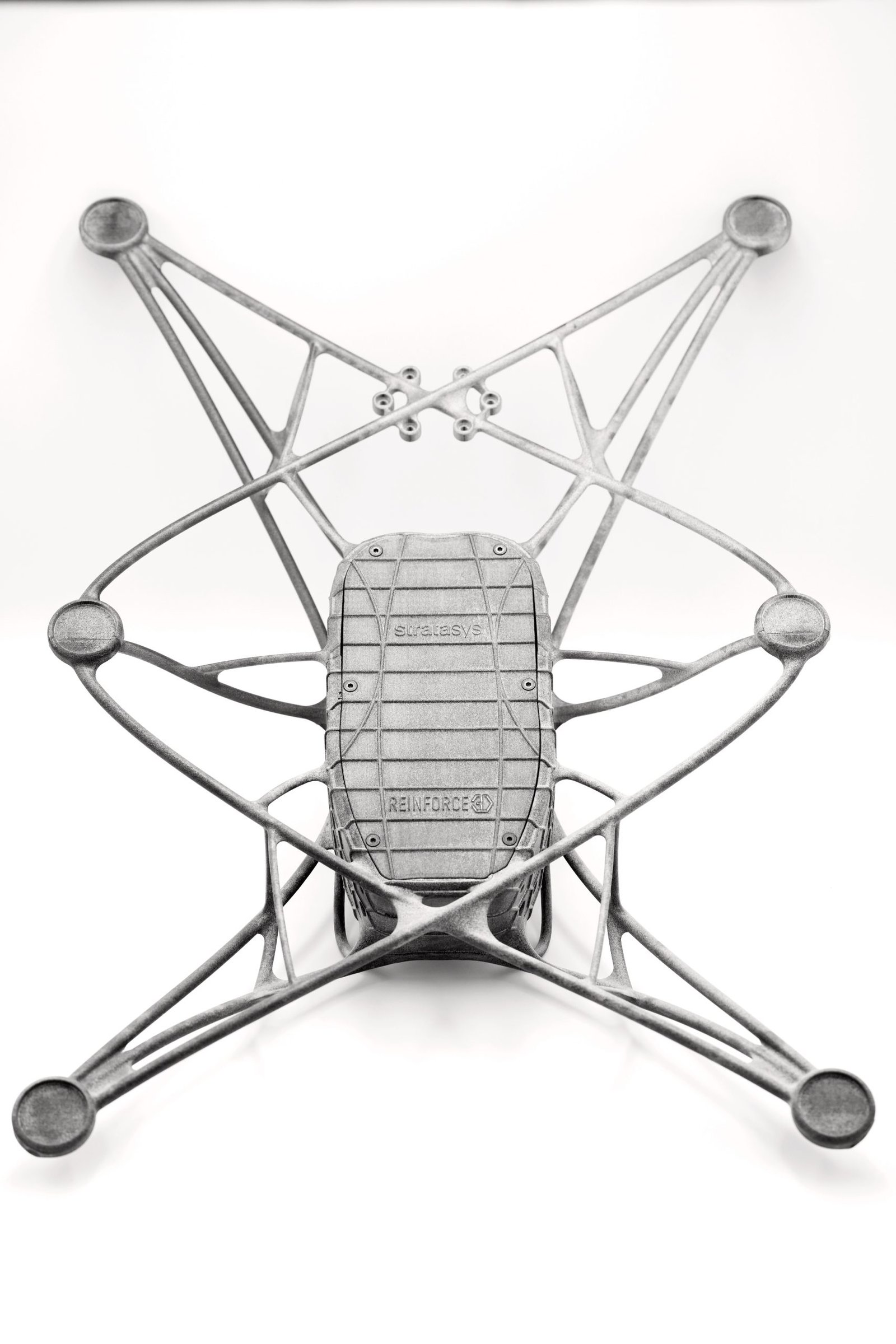
Powder bed production rounded out the announcement with SAF PA12 – Powered by Evonik. Evonik, a specialty chemicals company, is supplying the material for Stratasys’ SAF process. Stratasys said the new PA12 offers up to 14% lower total cost of ownership than its current SAF PA12 materials, without requiring additional licenses, hardware, or process changes. According to the company, the polymer is designed to produce strong, resilient, dimensionally accurate parts with consistent build quality, while lowering barriers to industrial powder bed adoption. “By combining reliability with lower operating costs, manufacturers can confidently scale production applications, streamline workflows, and expand the use of additive manufacturing across multiple parts and processes,” said Neil Hopkinson, Vice President of SAF Technology at Stratasys.
Stratasys targets workflow bottlenecks across materials, software, and production tools
Stratasys had already been focusing on the practical constraints that slow additive manufacturing adoption before this latest release. At Formnext 2025, the polymer 3D printing company introduced updates across FDM, SAF, P3 DLP, and software that addressed repeatability, thermal stability, post-processing effort, and uninterrupted production. Those additions included CoatReady for smoother F900 parts printed in ULTEM 9085, LayerControl+ on the Neo800+ to manage layer delays during SLA builds, and Enhanced Accuracy Mode for SAF PP on the H350 to improve dimensional control and reduce warping in larger builds. Other changes, including larger spool support on the Fortus FDC platform, new Origin accessories for part handling and curing, and validation of Ultracur3D RG 3280 for high-temperature tooling, pointed to the same theme: reducing manual intervention and tightening process control across production workflows.
That pattern continued at RAPID + TCT 2026, where Stratasys expanded its portfolio with materials and software aimed at specific manufacturing limits rather than broad platform messaging. ULTEM 1010 was added to the F3300, pairing a high-temperature polymer with a faster FDM system and built-in material drying for composite tooling and other demanding parts. On the Origin side, P3 Deflect 110 targeted end-use parts exposed to heat and mechanical stress, while Loctite 3D IND3785 Low Migration addressed regulatory requirements in food and pharmaceutical production. PolyJet ToughONE White and ToughONE Black extended the J3 and J5 toward repeated mechanical testing, and GrabCAD Print Pro added Measurement-Based Warped Adaptive Modeling to correct warping on Origin P3 parts using measured dimensional data. Read together, those earlier updates help explain the current announcement: Stratasys is trying to remove the technical and workflow barriers that still keep 3D printing from wider day-to-day use in engineering, medical, and industrial settings.
3D Printing Industry is inviting speakers for its 2026 Additive Manufacturing Applications (AMA) series, covering Energy, Healthcare, Automotive and Mobility, Aerospace, Space and Defense, and Software. Each online event focuses on real production deployments, qualification, and supply chain integration. Practitioners interested in contributing can complete the call for speakers form here.
To stay up to date with the latest 3D printing news, don’t forget to subscribe to the 3D Printing Industry newsletter or follow us on LinkedIn.
Explore the full Future of 3D Printing and Executive Survey series from 3D Printing Industry, featuring perspectives from CEOs, engineers, and industry leaders on the industrialization of additive manufacturing, 3D printing industry trends 2026, qualification, supply chains, and additive manufacturing industry analysis.
Featured photo shows Drone structure produced using Stratasys SAF PA12 powder. Photo via Stratasys.
