


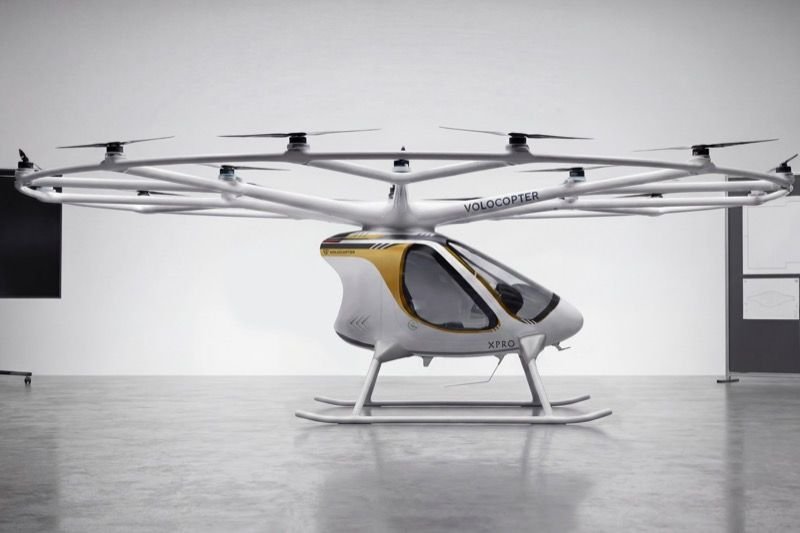
Volocopter has unveiled the VoloXPro, a fully electric ultralight multicopter developed for the general aviation market and targeting German ultralight-category certification by the end of 2026.
The two-seat aircraft is aimed at flight schools, flying clubs, air sports enthusiasts and sightseeing operators in Europe, with international markets targeted for professional passenger transport as an air taxi.
Parallel certification processes are under way in other European countries alongside the primary German approval effort.
Volocopter, which was founded in 2011 and is headquartered in Bruchsal, Germany, was acquired by Diamond Aircraft last year out of insolvency after challenges bringing its VoloCity air taxi to market.
Development throughout 2025 involved modularizing the product portfolio, realigning the supply chain and optimizing components in partnership with Diamond.
The aircraft shares components with the VoloCity, including flight-control computers and battery technology enabling certification credit to carry over from that program. Key specifications include 18 electrically powered rotors, a maximum take-off mass (MTOM) of 600kg (1,323lb), a payload of 154kg (340lb), a cruise speed of 43mph (70km/h) and a maximum range of 25 miles (40km).
A fly-by-wire control system and modular platform design allow multiple equipment configurations, from a single-screen glass cockpit with collision-warning assistance to higher-specification variants for professional operators. Component commonality with the VoloCity is said to contribute to competitive pricing for both operators and private buyers.
According to reports from the launch event at Aero Friedrichshafen the base version of the VoloXPro costs €490,000 (US$573,000).
David Bausek, chief technology officer at Volocopter, said, “With the ultralight VoloXPro, electric multicopter flying at the safety standard of a passenger aircraft — at the price of a luxury car — will become possible for private customers and commercial operators. Thanks to the fly-by-wire control system, flying is easier than ever before, and all of it is low-noise and emissions-free.”
The aircraft is also positioned as a training platform for pilots transitioning to next-generation powered-lift aircraft, with its electric vertical take-off and landing (eVTOL) architecture intended to support conversion onto other types in the powered-lift category.
