


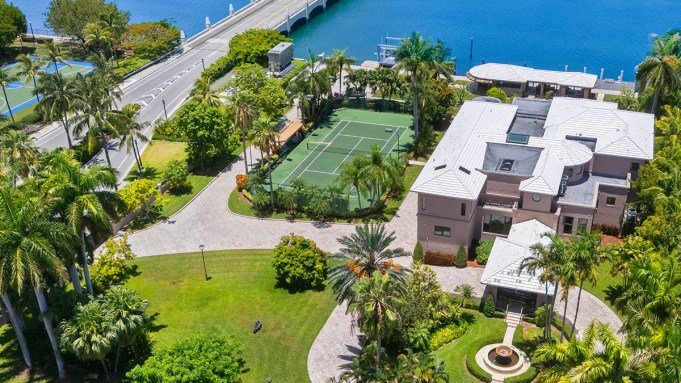
The internet has looksmaxxing. Billionaires have landmaxxing. While the first is about optimizing physical appearance, the second is about controlling something far more limited: space.
Coldwell Banker Global Luxury has dubbed the phenomenon “landmaxxing”—the race to acquire as much surrounding land as possible, often by purchasing neighboring properties to maximize privacy, preserve views, and create multigenerational compounds. According to the brokerage’s new 2026 Mid-Year Report, searches for land climbed 97 percent year over year, while queries for one-of-a-kind properties—including estates, castles, historic homes, branded residences, and private islands—jumped 146 percent.
“It’s about controlling their lifestyle and their surroundings,” explains agent Angel Nicolas of Serhant. Some clients buy neighboring properties to create a larger estate, while others hold onto them for future development or to pass down to the next generation. “Your home isn’t just the four walls you live in—it’s the entire experience of the neighborhood around you,” he says. “If you have the chance to own what’s next door, it can give you both peace of mind and flexibility for the future.”
Some of the country’s most recognizable billionaires are already putting the strategy into practice. Amazon founder Jeff Bezos has spent about $234 million assembling three waterfront estates on Miami’s Indian Creek Island. Meanwhile, Citadel founder Ken Griffin has spent more than a decade piecing together roughly 25 contiguous acres in Palm Beach, where he’s now developing what could become one of the world’s most valuable private residences.
In some cases, the land itself matters more than the house already sitting on it.
Earlier this month, a four-acre ocean-to-Intracoastal parcel in Manalapan that had been earmarked for a proposed $285 million spec mansion instead became one of the clearest examples of landmaxxing yet. Rather than letting the mega-home get built, neighboring billionaires Larry Ellison and WeatherTech founder David MacNeil split the property between themselves for a combined $67 million, using it to expand estates they already owned.

Featured Listing
The Pinnacle of Lake Sherwood Living
Lake Sherwood, CA
$19,900,000 USD
Featured Listing
Extraordinary Waterfront Estate on Long Lake, Maine
Harrison, ME
Price Upon Request
Featured Listing
1084 Wade Pasture Road | Luxury No Reserve Auction
Stowe, VTFeatured Listing
Waterfall Villa – The Ultra-Luxury Residence of Kamala in Phuket, Thailand
Kamala, Thailand
$13,900,000 USD


A waterfront Manalapan parcel was divided between neighbors Larry Ellison and David MacNeil.
Daniel Petroni
The strategy is showing up across the country, but few places illustrate it better than South Florida, where an influx of billionaires has collided with a finite supply of land.
“South Florida has become the epicenter of landmaxxing,” says Samantha Curry of Douglas Elliman. “We have seen an unprecedented level of wealth relocating here while our inventory for trophy waterfront properties is limited. The only way to secure the scale and privacy today’s high-net-worth buyers demand is through land assemblages.” Watching buyers like Bezos, Griffin, and Ellison quietly purchase neighboring parcels has reset expectations, she says. “Buying adjacent properties is about future-proofing your real estate footprint in a market where you literally cannot create more land.”
That scarcity has fundamentally changed the way deals happen.
“When land is this limited, control is key,” adds Dina Goldentayer of Douglas Elliman, who says buyers routinely pay what’s being called a “neighbor’s premium”—sometimes as much as 20 percent above market value—just to secure adjacent property before it reaches the open market. In prime neighborhoods like Indian Creek Island, along North Bay Road, and the Venetian Islands, unsolicited off-market offers have become standard practice.
For many, the extra land isn’t simply about having a larger estate—it’s about creating a self-contained lifestyle. Indeed, Goldentayer says she’s represented buyers who purchased neighboring homes—or even properties across the street—simply to create room for amenities like padel courts.
“The profile of today’s ultra-luxury buyer has evolved,” says Jeff Miller of ONE Sotheby’s International Realty. Many are relocating from places where larger estates are commonplace and arrive expecting the same level of space in South Florida. Once they secure neighboring parcels, they’re building guesthouses, expansive outdoor entertaining spaces, pickleball and padel courts, fitness studios, and wellness wings equipped with infrared saunas, cold plunges, and red-light therapy. “As privacy becomes harder to come by globally, having a self-contained, secure estate has become the ultimate luxury benchmark,” he says.
A Palm Island compound assembled from two neighboring lots sold for $40 million to the adjacent homeowner.
Mark Portnov, Real Media Vision / The Chad Carroll Group
The appetite for larger compounds has become so voracious that Chad Carroll of Compass says requests for them have become a regular part of his business.
“Five years ago, buyers were happy with a 20,000- to 30,000-square-foot waterfront lot,” Carroll says. “Today, many ultra-high-net-worth buyers are looking for true compounds with 200-plus feet of waterfront and two or more acres.” He recently sold a $40 million double-lot property on Palm Island, where the buyer already owned the neighboring estate, allowing the combined property to become one of the island’s largest private waterfront footprints.
The Coldwell Banker report suggests the appetite is only growing, with nearly 40 percent of the brokerage’s luxury specialists saying buyers are willing to overlook a home’s condition if it occupies the right piece of land. A dated residence can always be renovated—or demolished—but an adjacent lot with another 60 feet of beachfront or the ability to preserve an uninterrupted view may never come back on the market. In the era of landmaxxing, the ultimate flex in real estate isn’t a bigger house—it’s owning more of what surrounds it.
Authors

Abby Montanez

