


![Beechcraft stretched the standard Bonanza fuselage by 10 inches to create the A36. [Credit: Glenn Watson]](https://tbh.express/wp-content/uploads/2026/05/Used-Aircraft-Guide-Beechcraft-Bonanza.jpeg "Used Aircraft Guide: Beechcraft Bonanza")
When aviation fans think of World War II, sleek cutting-edge aircraft come to mind, like the North American P-51 Mustang, Lockheed P-38 Lightning, and even the Grumman Bearcat, whose speed and maneuverability made it capable of accomplishing just about anything except getting to the fight in time to take part.
Advancement in aircraft structures, engines, aerodynamics, and other technology blossomed during the war. As a result, the crop of combat aircraft rolling off assembly lines in the wake of the global conflict were leaps and bounds ahead of those making up the airborne arsenal when America entered the melee in 1941.
Nearly the opposite was true for the civil aviation fleet, which, due the absolute focus of industry on the war effort, had been stuck in neutral from the Pearl Harbor attack until the late 1940s. Across the country, the evidence was clear at small airports, where Piper J-3 Cubs, Aeronca 7AC Champions, B-series Taylorcrafts and other holdovers dating to the 1930s populated ramps, hangars, and tie-downs.
Design Departure
For private pilots, 1947 looked a lot like 1937—with one glaring exception. This was the year the Beechcraft Bonanza made its debut, and caused a sensation. Among the tail-dragging, rag-and-tube remnants of earlier decades, this modern, all-metal, flush-riveted monoplane with retractable tricycle landing gear and a distinctive V-tail must have looked like it had traveled through a time warp from decades in the future.
Sharing more in common with the latest military fighters than with other general aviation aircraft, the Bonanza demonstrated performance that was stunning for the time. Thanks to lightweight and refined aerodynamics, the earliest models with 165 hp engines could cruise at nearly 150 ktas. The V-tails, which were in production through the GA boom of the 1960s and ’70s, became top sellers and underwent many changes from engine and instrument upgrades to enlarged tail surfaces.
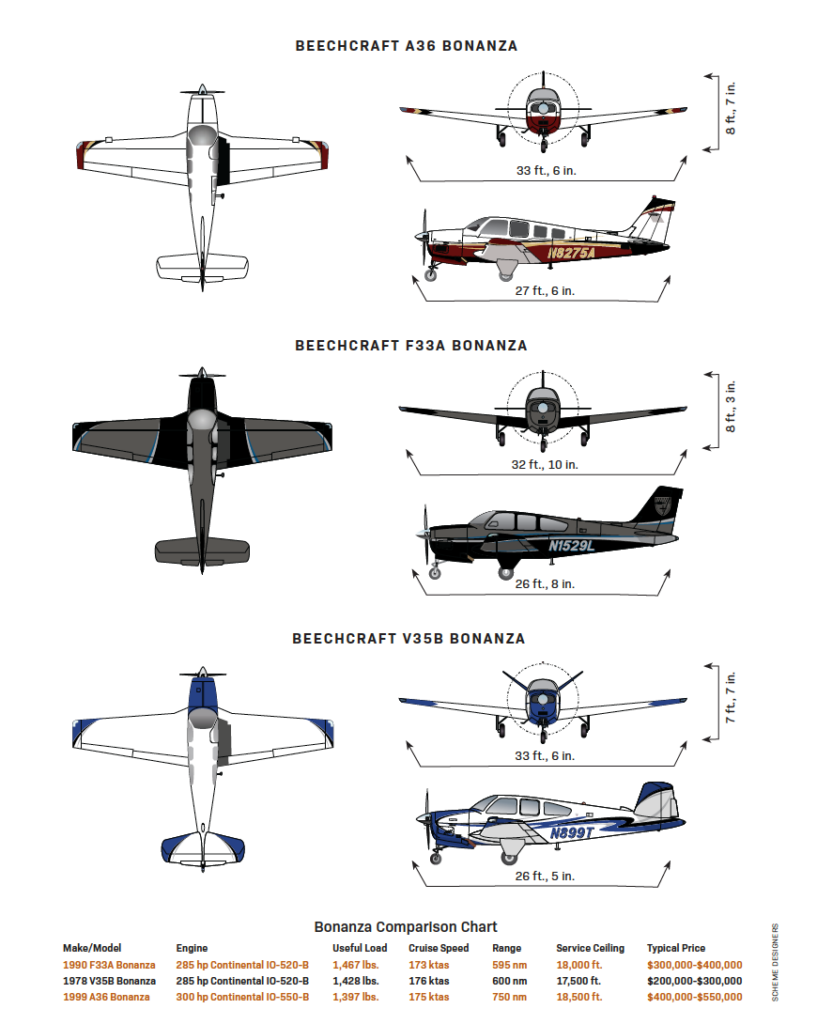
The Bonanza also morphed into new models like the “straight tail” Debonair, the later, more powerful F33A, and the stretched, six-place A36. While the Beechcraft stopped building V-tails in 1982, the Bonanza family was notable for having remained in production through difficult economic times that led manufacturers to severely cut output and discontinue many models during the 1980s.
The F33A continued through 1994, and the A36, which 20 years ago devolved into the G1000-equipped G36, is still being built, though the company last year said the line will shut down in the next year or two as soon as it completes current aircraft orders on backlog.
After decades of frequent changes both subtle and substantial, the Bonanza continues to attract buyers willing to pay a premium for new and used examples. The aircraft’s list of desirable traits has changed little since its earliest days. Its capability as an all-rounder with the rare combination of impressive cruise speeds and good short-field performance has helped the Bonanza carve out a perennial spot at the top of pilots’ wish lists.
Something for Everyone
With a diversity of models and more than 17,000 aircraft built over the decades, there are Bonanzas available to please a wide variety of owners. Younger pilots looking for a personal airplane akin to a vintage sports car with responsive handling and a rakish, midcentury design tend to gravitate toward the V-tails.
The A36 is better suited to larger families with cross-country travel plans and a need for a roomy, comfortable cabin. As automotive parallels go, the A36 is closer to a luxury SUV or crossover. In the middle, one could say, is the F33A, which appears to form the sweet spot for many owners, exhibiting a mix of stability and engaging handling that many pilots find just right.
![The extra length of the A36 gives the aircraft a distinctive, graceful appearance and a third row of seats. [Credit: Glenn Watson]](https://www.flyingmag.com/wp-content/uploads/2026/05/Beech-seats.jpeg)
It was the V-tail, however, that kicked off the Bonanza phenomenon that continues to this day, and it is doubtful that the airplane would have been so popular and lasted so long if not for that initial, distinctive design. For more than a decade after its introduction, the V-tail was alone in its category with no true competition that could match or even approach its performance.
Tales of the Tails
As an elementary school kid in northern New Jersey during the 1970s, I quickly learned to spot Bonanzas as they flew overhead.
There were many more GA airports in the area back then, and my father and I would stop by occasionally to watch airplanes arrive and depart. Bonanzas were among a few types that warranted special mention. This subgroup also included the futuristic-looking Cessna 310 and any biplane.
Dad and other adults who were into airplanes explained that Bonanzas were high-end models that outperformed most others. They were known in particular for their speed which, the observers said, was due in part to their low-drag V-tails. While that thesis might make intuitive sense, it turns out to be more legend than fact.
According to Thomas Turner, executive director of the American Bonanza Society’s Air Safety Foundation and longtime flight instructor, the Bonanza’s eye-catching empennage did not contribute to its impressive pace at cruise or enhance performance.
Indeed, the performance charts in the pilot’s operating handbook for the V-tail Model 35 and straight-tail Model 33 Bonanzas “were exactly the same,” Turner said.
So if there was a difference, Beechcraft did not think it was significant enough to mention.
The early Bonanzas were fast because they were light and aerodynamically efficient. Beechcraft shaved pounds from the aircraft by making its control surfaces out of magnesium, which is lighter than aluminum. The company made extensive use of wind-tunnel testing to fine-tune the Bonanza’s aerodynamics and eliminate drag. The V-tail simply gave the airplane the appearance of speed.
Ralph Harmon, the legendary Beechcraft designer who led the team developing the original Bonanza and author of the memoir Birth of the Bonanza, reportedly chose to give the aircraft a V-tail with the goal of turning heads.
“He selected the V-tail because it was a unique, highly visible design feature that would make it identifiable as a Beech product,” Turner said.
Though company founders Walter and Olive Ann Beech initially were skeptical, Harmon persisted and eventually sold them on it. Harmon’s instincts were correct, as the V-tail soon came to represent advanced technology, performance and sophistication in the GA market.
Model Evolution
With the initial Model 35 Bonanza, known as the straight 35, Beechcraft apparently went too far in its pursuit of weight reduction by omitting shear webbing from the main wing spar and making other design decisions that would later necessitate retroactive strengthening of the airframe. By 1950, the subsequent B35 had more power and the A35’s strengthened airframe, but there was more to come in terms of modifications and controversy.
Most pilots are aware of the panic that affected early V-tails following accidents involving in-flight breakups. Many were a result from overspeeding incidents, encounters with turbulence, and abrupt control inputs. Some critics believed the V-tail was an inherently dangerous design with a tendency to separate in flight.
![Beechcraft Bonanza cockpit [Credit: Glenn Watson]](https://www.flyingmag.com/wp-content/uploads/2026/05/Beech-front.jpeg)
To fully understand the V-tail’s travails, which led to its nickname of the “forked-tail doctor killer,” you have to consider the aviation scene at the 20th century’s midpoint. At that time the Bonanza was the latest thing, representing a major shift from the slow, spindly, fabric-covered aircraft that were familiar to most people. The Bonanza was also expensive, making it affordable only for well-to-do pilots, many of whom happened to be physicians.
Typical GA pilots of the late 1940s and early ’50s had learned to fly in lightweight taildraggers like Cubs, Taylorcrafts, and Luscombes. The transition to the Bonanza was a broad jump involving speeds and aerodynamic forces that most had never experienced. The clean design that helped the Bonanza cruise quickly also allowed it to gain dangerous speeds rapidly when in even a shallow dive. When pilots found themselves traveling too fast in a descent, they sometimes pulled the yoke aft with excessive force or made other severe control inputs, causing airframe stress that could lead to disaster.
V-tail Bonanzas generally did not spontaneously break up in level flight, but lengthy investigations found that their design was more prone to breakups than certain others during abnormal flight situations involving excessive speed.
Choosing a V-Tail
While experts often advise shoppers to avoid the straight 35 Bonanzas, other so-called first-generation or E-series models, built through 1956, can be ideal entry points for newcomers to the Bonanza community. They are among the most economical to purchase and are strong performers, though they might require more attentive maintenance than later versions.
“If you are a hands-on type of person who buys spare parts when you find them instead of when you need them, then you will enjoy the experience of flying an E-series Bonanza,” Turner said. “On the other hand, if you want to lay down your credit card and pay someone to maintain your airplane and to have parts readily available [stick with the third-generation V-tails].”
Those were built from 1964 through 1982, and Turner says are “essentially the same” as today’s models from an operational and maintenance point of view. In between, the second generation, spanning from 1957 through 1963, is a potential sweet spot. Bonanzas from this period have fuel-injected engines, reinforced airframes, better panel layouts, and improved systems. They offer a measure of midcentury chic similar to that of earlier versions but are more capable and more thoroughly supported.
Straight-Tail Arrives
Beechcraft enjoyed the luxury of having more than a decade to sell the Bonanza with practically no competitive aircraft on the market.
By the late 1950s, though, other models began to appear. The most immediate threat came in the sleek form of Piper’s PA-24 Comanche, which sported a conventional tail but still had a futuristic look, especially when compared with the rest of Piper’s lineup, which included the fabric-covered Super Cub and Tri-Pacer. The Comanche was not as bold and innovative as the Bonanza, but it cost only about two-thirds as much, and that was more than enough to draw away potential customers.
![The four-place straight-tail F33A Bonanza started out as the Debonair. [Credit: Glenn Watson]](https://www.flyingmag.com/wp-content/uploads/2026/05/Beech-2-1024x613.jpeg)
Beechcraft responded with the Model 33 Debonair, which was a stripped-down Bonanza airframe with a conventional tail, a less-powerful engine, and a lower price. It was meant to compete with the Comanche, but it soon became clear that customers viewed it as a Bonanza for people who simply preferred traditional empennage.
“What Beechcraft found was that people were spending more on optional equipment to bring the Debonair up to Bonanza standards,” Turner said. “It took several years, but starting with the E33 model in 1968, the company officially renamed the airplane the E33 Bonanza. The F33A that followed continued in production through 1994 and remains popular on the used market. For many pilots, the 33 likely is the best all-round Bonanza There are even special versions, the E33C and F33C, that were strengthened and rated for aerobatics, but they are rare, with fewer than 200 built in total.”
A36 Is King
The last Bonanza standing was the B36, which became the G36 in 2005. This stretched six-seat model, which Beechcraft initially marketed as a utility aircraft to compete with the Cessna 206, also went through many changes driven by customer preferences.
The first Model 36s went on sale in 1968. At first they had four seats and a huge baggage area designed for cargo. Large double doors on the right side gave access for loading large items.
Again, Beechcraft had built the right aircraft for the wrong market. Customers looking for the ultimate personal airplane began ordering the 36 with six seats, plush interiors, and other extras to make the cabin more comfortable for family and business travel. Beechcraft got the idea and in 1970 renamed it the A36 and switched its focus more toward the personal travel market.
![A pair of Beechcraft Bonanzas [Credit: Glenn Watson]](https://www.flyingmag.com/wp-content/uploads/2026/05/2-Beeches-1024x700.jpeg)
The extra-large cabin is a boon for passengers, who have more options for stretching out when not all of the seats are occupied. The aircraft also solved a long-standing issue that has vexed Bonanza pilots for decades. It is easy to wind up with the center of gravity too far aft when loading the “short body” Bonanzas. Indeed, because the fuel tanks are ahead of the main wing spar, the center of gravity shifts rearward as fuel burns off.
If you are heavily loaded but within weight and balance limits at takeoff, you will almost surely be out of limits as fuel gets low. As a result, Bonanza pilots with heavy loads are accustomed to making regular stops to top off the tanks for the sake of proper balance. The A36’s longer fuselage with the wing mounted further eliminates this problem. Indeed, if you are flying with just two people in the front seats and full tanks, you will need to add ballast to the rear to avoid being excessively nose-heavy.
As mentioned, the G36 is in wind-down mode. The used market will remain active, though, with many opportunities to find the Bonanza that suits you best. So start doing your homework.
Perhaps the most important move that a prospective Bonanza buyer can make is to join the American Bonanza Society.
“You really have to join the type club because they offer so much support and make ownership easier,” said Zach Stubbs, who bought his F33A after years of flying with a club and later entering a partnership with the aircraft’s previous owner.
Stubbs said he understands why many people are reluctant to get involved in an aircraft partnership but feels the experience helped him avoid some of the potential shocks of solo ownership. He knew the airplane’s longtime owner well, and they worked out a detailed agreement on paper regarding how the partnership would work. In the end, his partner told him what to expect, helped familiarize him with the airplane, and essentially prepared him to take full ownership in due time.
![Zach and Christie Stubbs have traveled the Midwest in their F33. [Credit: Jason Thomas Crocker]](https://www.flyingmag.com/wp-content/uploads/2026/05/Beech-Stubbs.jpeg)
“He made the process easier, but at times it was still a roller coaster,” Stubbs said, noting that his partner had not flown the aircraft often during the last few years, so when he began flying regularly, problems surfaced.
“The airplane went from flying a few dozen hours a year to 150 hours a year. Things started to break,” he said.
While his first year as a solo owner was challenging, he felt the Bonanza community was always ready to help. Now he feels at home in the F33, usually flight planning for 174 ktas between 7,000 and 9,000 feet, where the air is smooth and he can stay clear of most airline and GA traffic.
Based in Des Moines, Iowa, Stubbs and his wife, Christie, have traveled all over the Midwest in the F33.
“Downtown Chicago is an hour and a half away, so that is a regular trip,” he said. “We have also flown to Nashville [Tennessee], Austin [Texas], and to visit relatives in Missouri. Between Canada and Mexico is our playground.”
Stubbs’ advice for getting the most out of your Bonanza is to fly as often as possible, which helps maintain the pilot’s proficiency and the airplane’s health. He recommends debriefing after every flight and noting areas of potential improvement. One important detail he feels he has overlooked lately is the need to smell the roses occasionally.
“Sometimes I have to remind myself to take a minute to relax, look out the window and enjoy the ride,” he said.
This column first appeared in the April Issue 969 of the FLYING print edition.
