


Voltage Vessels, based in Hawaii, has released Eclipse X9, a composite that combines recycled PETG with basalt fiber reinforcement for large-format additive manufacturing (LFAM). After several years of development, the material is now commercially available as both pellets and filament, and is undergoing evaluation at several LFAM facilities across different printer platforms.
The company is aiming the material at marine structures, tooling, buoys, unmanned surface vehicles (USVs), infrastructure parts, and other applications exposed to harsh coastal conditions.
Pellet supply covers robotic extrusion systems in the Caracol/CEAD category and gantry machines of the CMS/JuggerBot type, with bulk volumes offered for contract manufacturing. The filament comes in 1.75 mm and 2.85 mm diameters and runs on machines ranging from desktop FFF printers up to large-format units such as the Elegoo OrangeStorm Giga class.
Performance data and marine validation
Independent validation was carried out by the Advanced Structures and Composites Center (ASCC) at the University of Maine. Mechanical testing followed ASTM D638 and D790, complemented by marine scantling analysis under ISO 12215. In saltwater immersion trials lasting between 24 and 26 months, the composite kept more than 90% of its strength.
The published figures list 108.2 MPa tensile strength, 112.98 MPa bending strength, a 12 GPa bending modulus, heat deflection above 70°C, and water absorption under 0.4%. Because basalt fiber is nonconductive, transparent to radio frequencies, and generates a low radar signature, Voltage points to defense and autonomous maritime systems as natural fits. The material also supports closed-loop mechanical recycling: finished parts can be shredded, converted back into pellets, and printed again without discarding material.
The Nāia 25 demonstrator
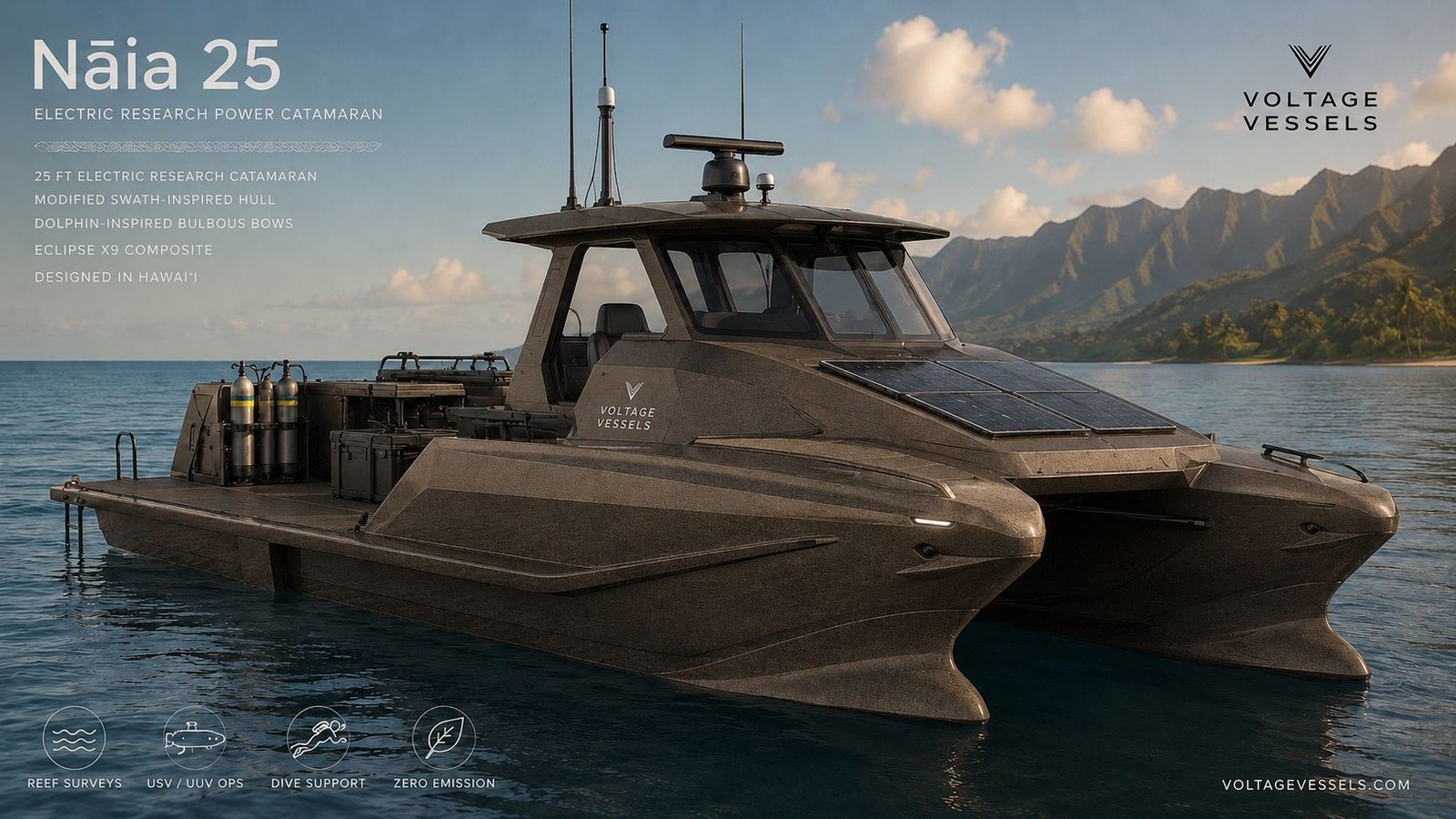
To illustrate what the composite can do at vessel scale, Voltage is designing the Nāia 25, a 25-foot electric research power catamaran concept built around Eclipse X9. The boat remains in the design and engineering phase, but production trials of the material itself are already underway, with early feedback centering on printability, bead consistency, surface quality, stiffness, and handling.
Color development is the next step. The company is testing pigment directions for marine service, among them naval gray, bronze sand, and lighter shades intended to limit heat buildup while keeping the visible basalt fiber texture.
Beyond the boat, Voltage frames the catamaran as proof of what a platform-agnostic material makes possible: electric research vessels, USVs and autonomous systems, ocean monitoring buoys, reef and coastal restoration structures, tooling and molds, marine infrastructure, and distributed manufacturing near the point of need. “The material travels. The production stays local,” the company stated.
Voltage, which describes itself as a materials company that manufactures rather than a manufacturer of materials, is taking sample orders, technical evaluations, and application-specific inquiries.
Making composites that survive the ocean
Voltage’s strategy attacks a logistics gap as much as a materials one: marine structures are typically laminated from fiberglass at fixed facilities and shipped to where they’re used, while existing printed marine composites have lacked validated long-term saltwater performance. By pairing a recycled thermoplastic with basalt fiber and keeping the formula platform agnostic, the company is positioning Eclipse X9 as the feedstock for distributed manufacturing near the point of need, a pitch with clear defense overtones.
Previously, the Voltage Vessels submitted a six-meter printed rigid hull inflatable boat for U.S. maritime defense evaluation, arguing that hulls printed from digital files at regional Indo-Pacific facilities could replace the model of building boats stateside and shipping them forward.

The push toward printed, recycled marine structures is well established. A collaboration between Italian LFAM specialist Caracol and Spain’s V2 Group produced a 6-meter monolithic catamaran for open waters using robotic extrusion of glass fiber-reinforced recycled polypropylene, treating the build as a test case for industrializing boat production without molds.
The University of Maine’s Advanced Structures and Composites Center, the lab that validated Eclipse X9, is itself a heavyweight in this space. The center printed two large logistics support vessels for the U.S. Marine Corps from fiber-reinforced polymer composites, one of them then the largest vessel ever additively manufactured, designed to carry shipping containers or a full rifle squad with three days of supplies.
The strategy in printed marine manufacturing is shifting from proving boats can be printed to proving the materials can survive the ocean.
3D Printing Industry is inviting speakers for its 2026 Additive Manufacturing Applications (AMA) series, covering Energy, Healthcare, Automotive and Mobility, Aerospace, Space and Defense, and Software. Each online event focuses on real production deployments, qualification, and supply chain integration. Practitioners interested in contributing can complete the call for speakers form here.
To stay up to date with the latest 3D printing news, don’t forget to subscribe to the 3D Printing Industry newsletter or follow us on LinkedIn.
Explore the full Future of 3D Printing and Executive Survey series from 3D Printing Industry, featuring perspectives from CEOs, engineers, and industry leaders on the industrialization of additive manufacturing, 3D printing industry trends 2026, qualification, supply chains, and additive manufacturing industry analysis.
Featured image shows Nāia 25, a 25 ft electric research catamaran concept. Image via Voltage Vessels.
