


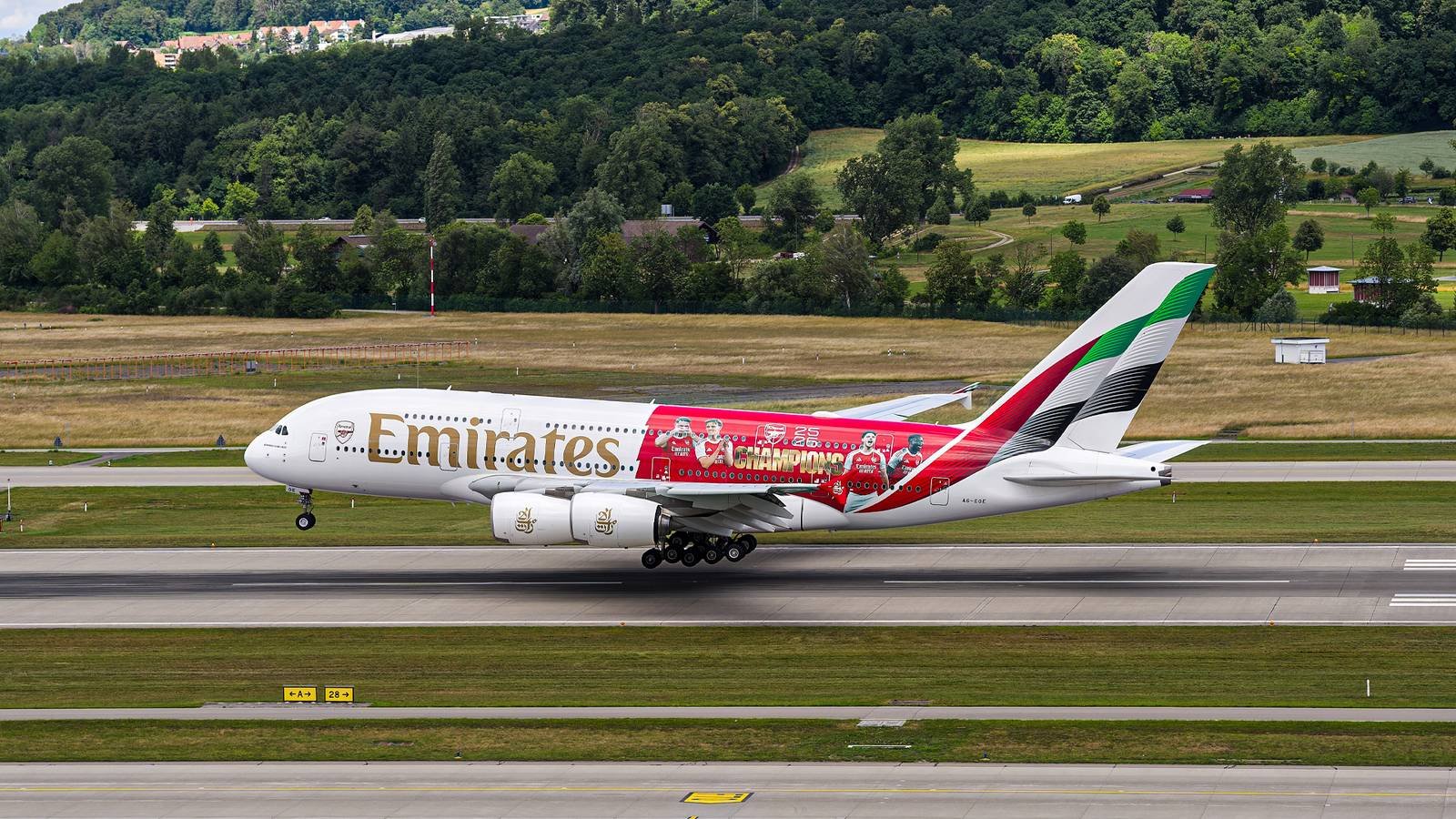
Sending a 400-seat, multi-million-dollar widebody jet engineered for 15-hour ocean crossings on a 45-minute domestic hop appears operationally absurd on paper. Every single day, airlines across Asia, Europe, and the Americas do exactly that, using heavy twin-aisle aircraft on schedules that cover sectors well under 300 miles (483 km). From superjumbos gliding between neighboring Middle Eastern capitals to twin-engine giants shuttling between European financial hubs, these massive long-haul flagships routinely operate flights where cruising altitude is barely reached before descent begins.
Why burn expensive flight cycles and subject long-range airframes to repetitive landing stress on routes designed for narrowbodies? Looking at carriers like All Nippon Airways, Emirates,  British Airways, and
  Delta Air Lines, there are a number of reasons. Facing severe airport slot caps, lucrative belly cargo demand, strict pilot training schedules, and complex international tag-route economics, airlines turn to widebodies to reach profitability where smaller jets reach their absolute limits.
Keeping Up With Exceptional Demand

Many airports around the world suffer from severe runway slot congestion, something that is very hard to fix when expansion is limited. Airports such as  Tokyo Haneda (HND), Seoul Gimpo (GMP), and
  London Heathrow (LHR) operate at near-total capacity, meaning aviation authorities cannot grant airlines additional takeoff or landing slots during peak hours.
When an airline reaches the maximum number of flights it can legally operate per hour, the only way to expand passenger capacity is through the aircraft itself. Here, carriers can swap a standard 180-seat narrowbody like a Boeing 737 or Airbus A320 with a widebody jet capable of carrying more than double the passenger load.
In South Korea, Korean Air and Asiana Airlines regularly deploy Airbus A380s, Boeing 777s, and Airbus A330s on the 280-mile (450 km) corridor connecting Seoul Gimpo and Jeju International Airport (CJU). Handling just shy of 15 million passengers in 2025, according to OAG, this route is generally seen as the busiest air link on Earth, where narrowbody aircraft cannot keep pace with commuter volume.
Similarly, All Nippon Airways operates high-density Boeing 787-10s configured with up to 429 seats on 510-mile (820 km) hops between Tokyo Haneda and Sapporo Chitose (CTS). Operating a widebody on these short sectors allows carriers to move hundreds of travelers per hour while consuming only a single airport slot per departure.
High-density commuter traffic across Asia has relied on widebody aircraft on its shorter routes for a long time now, which is viewed as a unique instance when looking at global airlines. Now even airlines outside of Asia have started following on. While massive passenger numbers justify flying multiple-aisle aircraft between crowded Asian hubs, European legacy carriers routinely deploy widebody flagships on short regional routes where the passenger cabins are far from full.
Aircraft On The Ground Make No Revenue

European carriers generally prioritize schedule optimization and pilot line training rather than focusing solely on filling seats. When a widebody completes an overnight intercontinental journey and lands at its hub early in the morning, leaving a multi-million-dollar asset parked until a late-evening departure wastes valuable utilization time, as outlined by McKinsey. Concurrently, when airlines induct next-generation aircraft into their fleets, newly rated pilots need to rapidly accumulate takeoff and landing cycles to finalize their commercial certifications.
Flying short regional sectors solves both of these expensive logistical conundrums together. British Airways heavily utilized the 770-mile (1,239 km) corridor between London Heathrow and  Madrid Barajas (MAD) to rapidly rack up cycles for crews transitioning to the Airbus A350-1000. Similarly,
  Lufthansa fills in daytime schedule gaps by using Boeing 787-9s and Boeing 747-8s on the brief 186-mile (299 km) domestic shuttle between Frankfurt (FRA) and Munich (MUC). Operating a European commuter route allows a single flight crew to log four takeoffs and landings in one shift, an objective that would take days to achieve on a traditional 12-hour transatlantic roster.
Treating these aircraft solely as passenger shuttles or training platforms ignores a massive secondary revenue stream. While passenger ticket sales on a short-haul widebody flight might barely cover the fuel burn, the most lucrative payload often sits completely out of sight on the lower deck, and plenty of airlines have not missed the mark when it comes to leveraging this space.
When Seats Do Not Need To Be Filled

Widebody belly freight can make a massive difference on short-haul flight economics by decoupling profitability from seat occupancy rates. Narrowbody aircraft like the 737 or A320 rely almost entirely on passenger tickets and loose bulk baggage to cover operational costs, but twin-aisle widebodies possess lower decks specifically engineered to accommodate standardized Unit Load Device (ULD) containers. On high-volume regional trade corridors, freight forwarders purchase palletized underbelly space for time-sensitive air cargo, high-tech components, and cold-chain pharmaceuticals. Filling seats becomes far less critical, because widebody flying a two-hour regional sector can generate higher total revenue from its lower-deck freight holds than from a fully booked passenger cabin upstairs.
The almost cargo-first dynamic dictates daily operations across major East Asian manufacturing nodes. On the 501-mile (806 km) route between  Hong Kong International Airport (HKG) and Taipei Taoyuan, carriers like Cathay Pacific, EVA Air, and China Airlines routinely use Boeing 777-300ERs and Airbus A350-900s rather than single-aisle jets. A 777-300ER can accommodate up to 44 standard LD3 cargo containers, carrying over 80,000 pounds (36,287 kg) of belly freight alongside a full passenger load. Operating a widebody across this short strait allows airlines to transport dozens of tons of semiconductor components and e-commerce shipments between major technology supply chains without waiting to build up dedicated freighter flights.
Commoditizing lower-deck cargo holds makes short-haul widebody flights commercially viable within a single hub’s regional sphere. This is not the limit, however, as network planners also employ heavy twin-aisle aircraft in even more complex, multi-stage international flight patterns that extend far beyond simple point-to-point regional routes.
Just 12 Minutes Long?

In practice, these microscopic legs are triangular routing tags, fifth-freedom sector additions, or hub repositioning hops designed to maximize aircraft productivity on long-haul multi-stop itineraries. For example, operating nonstop long-haul flights from a major European or North American hub to every secondary destination in the Caribbean, Central Africa, or the Pacific is economically infeasible due to limited local passenger demand. Instead of dispatching two separate widebodies across the ocean, network planners often combine two nearby destinations into a single intercontinental service, linking them with a brief intra-regional hop.
The most dramatic example of this triangular efficiency is  Air France‘s 16-mile (26 km) shuttle between Maya-Maya Airport (BZV) in Brazzaville and N’djili Airport (FIH) in Kinshasa, separated only by the Congo River. Air France uses a 777-300ER on a Paris–Brazzaville–Kinshasa–Paris routing, with the 12-minute inter-capital flight operating primarily to reposition the widebody before returning home. Similarly, British Airways operates a 777-200ER on a 62-mile (100 km) sector between Antigua (ANU) and St. Kitts (SKB) in the Caribbean, while Ethiopian Airlines utilizes fifth-freedom rights to carry passengers on a 240-mile (386 km) 787-9 leg connecting Stockholm Arlanda and Oslo Airport.
Operating Airline | Aircraft Variant | Tag / Fifth-Freedom Route | Sector Distance | Routing Context |
Air France | Boeing 777-300ER / Airbus A330 | Brazzaville (BZV) to Kinshasa (FIH) | 16 miles (26 km) | Triangular Paris intercontinental tag leg |
British Airways | Boeing 777-200ER | Antigua (ANU) to St. Kitts (SKB) | 62 miles (100 km) | Caribbean multi-stop London Gatwick routing |
KLM | Boeing 777-200ER / 787-10 | Zanzibar (ZNZ) to Dar es Salaam (DAR) | 45 miles (73 km) | East African coastal triangle to Amsterdam |
Ethiopian Airlines | Boeing 787-9 | Stockholm (ARN) to Oslo (OSL) | 240 miles (386 km) | European fifth-freedom extension from Addis Ababa |
While these multi-stop networks resolve yield challenges for international carriers, repeatedly cycling heavy widebodies through rapid ascents and descents creates a noticeable mechanical penalty behind the scenes. Pressurizing a massive fuselage multiple times a day makes structural components expand and contract far more frequently than airframe engineers originally intended.
Over 600 Passengers On One Aircraft

Operating long-haul widebodies on brief domestic hops comes at a significant cost measured in pressurization cycles rather than flight hours. Aircraft fuselages are engineered as sealed pressure vessels; every departure inflates the cabin structure to an internal equivalent altitude of 6,000 to 8,000 feet (1,828 to 2,438 meters), and every landing deflates it. On a 14-hour intercontinental flight, this stress cycle occurs once every 7,000 miles (11,265 kilometers). On a 45-minute regional shuttle, the airframe undergoes that same structural expansion and contraction every 200 miles (322 kilometers), rapidly accelerating metal fatigue in aluminum skin panels, door surrounds, and rear pressure bulkheads.
To survive this relentless cycle of stress, manufacturers historically built purpose-engineered short-range widebody variants, many of which were for domestic Japanese routes.  Boeing developed the 747SR and the 568-to-660-seat 747-400D, removing drag-reducing winglets, which provided negligible efficiency gains on short hops, and heavily reinforcing the wing spars, undercarriage, and fuselage pressure bulkheads. As noted by Airline Reporter and Ready For Takeoff, one ANA 747-400D accumulated over 33,000 pressurization cycles before retirement, more than double the cycle life of a standard long-haul 747.
The trade-off between structural wear and operational revenue prompts airline asset managers to determine the exact point at which short-haul yield justifies early airframe retirement. As lightweight composite widebodies constructed from carbon-fiber-reinforced polymers replace conventional aluminum airframes, the fundamental physics of fatigue resistance is shifting significantly. As a result, the role these widebodies play on these shorter routes is also evolving.
Can Narrowbody Aircraft Compete?

The arrival of carbon-composite widebodies like the A350 and 787 is rewriting the economic rules of high-cycle regional flying. Unlike traditional aluminum fuselages that suffer from metal fatigue under repetitive pressurization cycles, composite materials exhibit far greater fatigue resistance and corrosion immunity. Introducing this material evolution allows carriers like Japan Airlines and All Nippon Airways to deploy standard international composite widebodies on short domestic hops without requiring heavy, specialized structural reinforcement modifications.
Evolving high-capacity narrowbody developments, such as the 244-seat Airbus A321neo, are beginning to siphon off medium-density short-haul routes. However, on mega-corridors like Seoul Gimpo to Jeju or Tokyo Haneda to Sapporo, where passenger throughput demands over 400 seats per departure slot, narrowbody aircraft cannot simply displace the widebody. Order books for high-density 787-10s and A350-900s confirm that Asia’s flag carriers will continue to rely on twin-aisle jets for domestic mass transit through the decade ahead.
Ultimately, using intercontinental flagships on brief regional sectors is not an operational anomaly, but an excellent lesson in asset optimization. Slot constraints are only worsening at global mega-hubs all over the world, so the ability to flex multi-million dollar widebodies between overnight long-haul crossings and daytime regional shuttles is still one of the most powerful tools in airline revenue management.
