


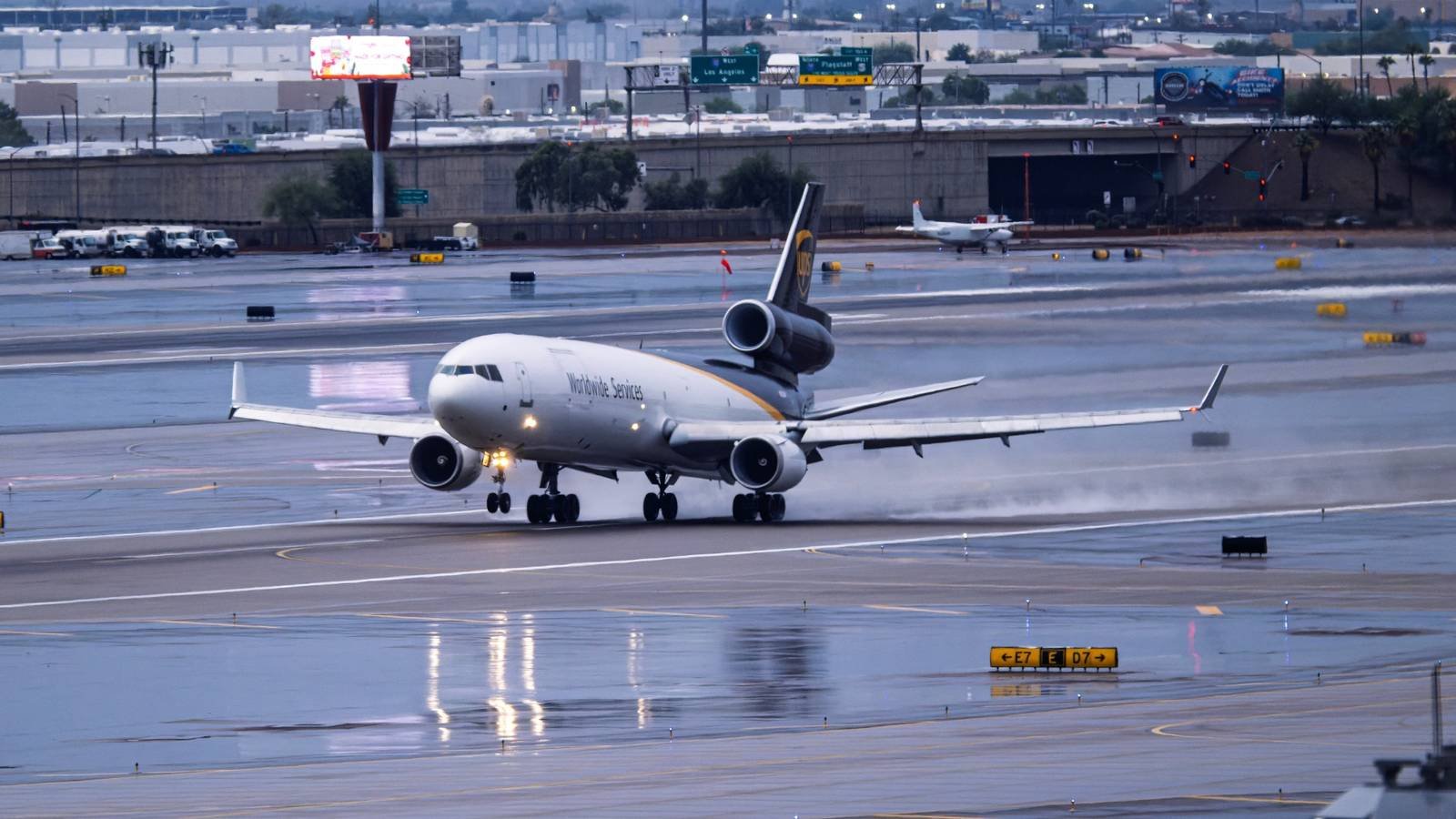
The widow and family of a crew member who lost their life during the UPS MD-11 crash in November 2025 have launched a case against Boeing, General Electric, and VT San Antonio Aerospace. The family is suing these organizations for wrongful death and negligence, considering the nature of the crash, based on the preliminary report released by the NTSB.
During the incident, the aircraft’s left engine was engulfed in flames before detaching from the wing during takeoff. Unfortunately, the aircraft crashed, resulting in 15 lives lost, including the three crew members onboard the aircraft.
Engine Separating From A Wing Is No Accident
Following the release of the NTSB’s preliminary report, it was found that the left engine of  UPS Airlines Flight 2976 caught fire and detached from the wing upon takeoff, causing the plane to crash soon thereafter. The relief officer onboard this flight was Captain Dana Diamond ,and reports from WDRB state that the pilot’s family has now launched a lawsuit against Boeing, General Electric (GE), and VT San Antonio Aerospace, the organization that performed maintenance on the aircraft.
The lawsuit launched against the three organizations claims wrongful death, negligence, loss of consortium, and related damages “for the multiple failures of the defendants that contributed to the engine separation and resulting crash”. The lawsuit is requesting punitive damages and a trial by jury for this case. As per the interim report, the aircraft had spent over a month prior to its crash in San Antonio, undergoing maintenance related to the aircraft’s fuel tank.
WDRB published the following quote from the attorney representing the Diamond family, Mark Lanier, regarding this lawsuit:
“When an engine separates from a wing seconds after takeoff, that’s not an accident,
That’s a failure by the companies responsible for building and maintaining that aircraft.”
More About The Crash In November

The crash occurred on the evening of November 4, when the 34-year-old McDonnell Douglas MD-11 freighter jet operated by UPS was taking off from Louisville International Airport (SDF). As per the initial findings and reports, the aircraft’s left engine caught fire just as it was taking off, and then completely detached from the aircraft’s wing. Data showed that an alarm was sounded on the flight deck for a duration of 25 seconds.
The aircraft crashed close to the airport site. The loss of an engine (and the power it provided), along with the mass imbalance of a missing engine, prevented the aircraft from achieving lift as it should have, and negatively affected the stability and control of the aircraft. 15 lives were lost during this crash, including all three crew members onboard and 12 people on the ground.
Immediately after the incident, major operators of the MD-11, which include UPS and Fedex Express, grounded their entire fleet of the aircraft type, citing it was “out of an abundance of caution and in the interest of safety.” Following this, UPS made the decision to retire its entire subfleet of over two dozen MD-11 aircraft. However, FedEx, it appears, is still not ready to retire these tri-jets, and the operator’s fleet of 29 MD-11s hopes to return to commercial operation soon.

Trust In The Trijet: Why FedEx Refuses To Retire The MD-11
FedEx has some unique advantages that allow it to return the MD-11 to the air this year.
A Known Issue With The Engine Mounting

In a report released by the NTSB back in January, it was noted that a failure of the engine mounts on the aircraft caused the aircraft’s engine number one to separate. It added that the issues with the engine mounts were a known problem with the aircraft type, with records showing a service letter  Boeing had issued to all operators of the aircraft type in 2011 focused on this problem.
The service letter stated the MD-11 would require regular inspections of bearing assembly at the engine mounts (previously required only at five-year intervals), and included recommendations for replacement parts and a new design for the bearing assembly. However, this was not made mandatory. Boeing at the time stated that the bearing failure would not adversely affect safety of flight.
Ultimately, it is up to the NTSB to investigate every aspect of this crash and evaluate the root cause. This includes evaluating Boeing’s reasoning on the flight safety not being affected, and evaluating the maintenance logs. The full picture of this crash will only be clear once the NTSB releases its final report.
