


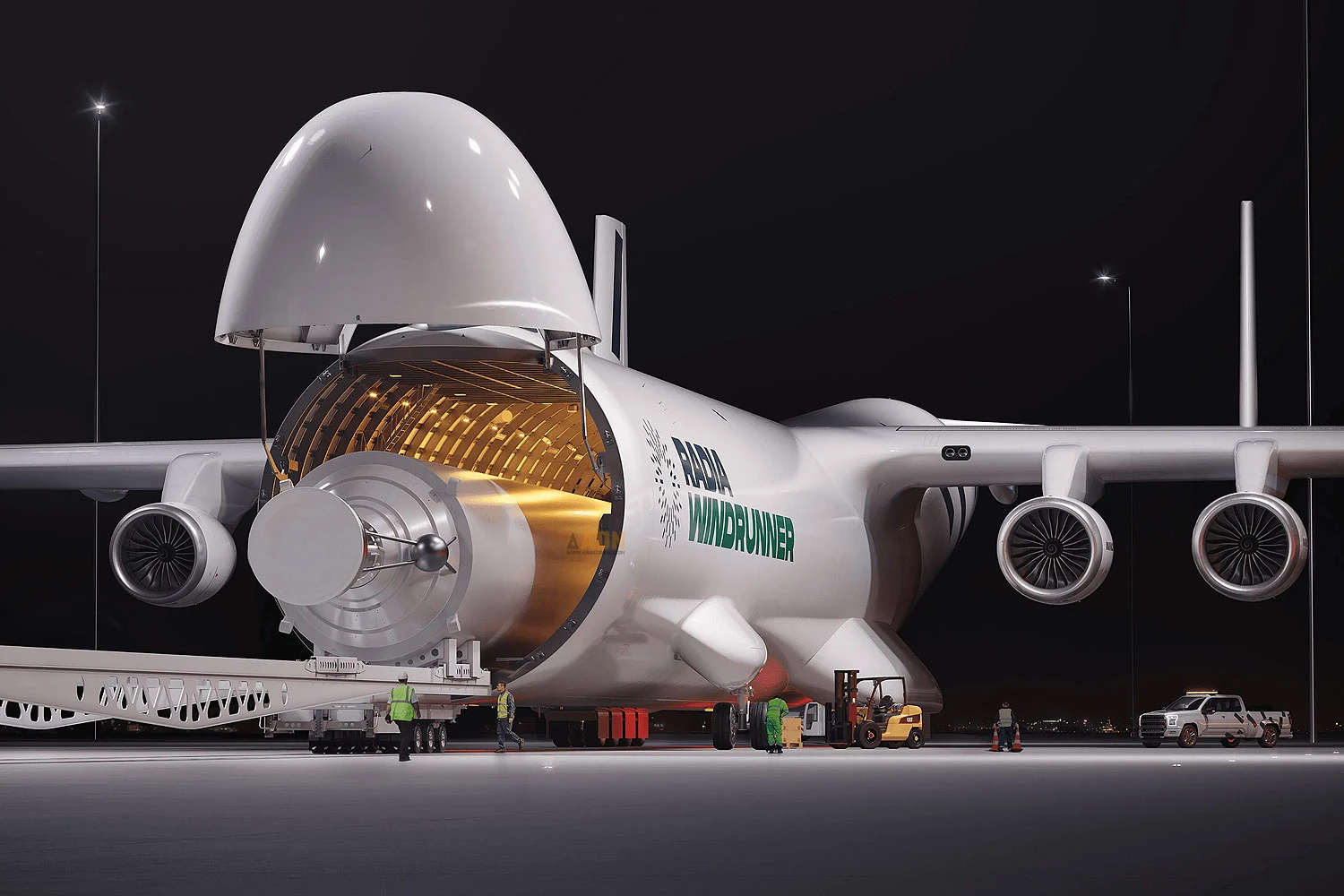
Radia is advancing development of the WindRunner, the extraordinary 109-meter-long cargo aircraft conceived to transport oversized loads that cannot fit inside conventional freighters. The U.S. company now says the program is entering the industrialization phase, with around two dozen suppliers under contract and a first flight still targeted for 2030.
Originally developed around the challenge of transporting very large wind turbine blades, the WindRunner has since been promoted for other specialized missions, including aerospace logistics and military airlift. Its enormous cargo hold, rather than maximum payload, remains the defining feature of the design.
Radia founder and CEO Mark Lundstrom told Aviation Week that the company has moved into the industrialization phase after assembling a supply chain that includes established aerospace manufacturers responsible for major structures and systems.
Designed around cargo volume rather than maximum weight, the WindRunner measures 356 ft. (108.5 m) long and has a wingspan of 261 ft. (79.6 m). Its cargo compartment has a volume of 242,000 ft³ (about 6,850 m³) and can accommodate loads up to 344 ft. (104.9 m) long.
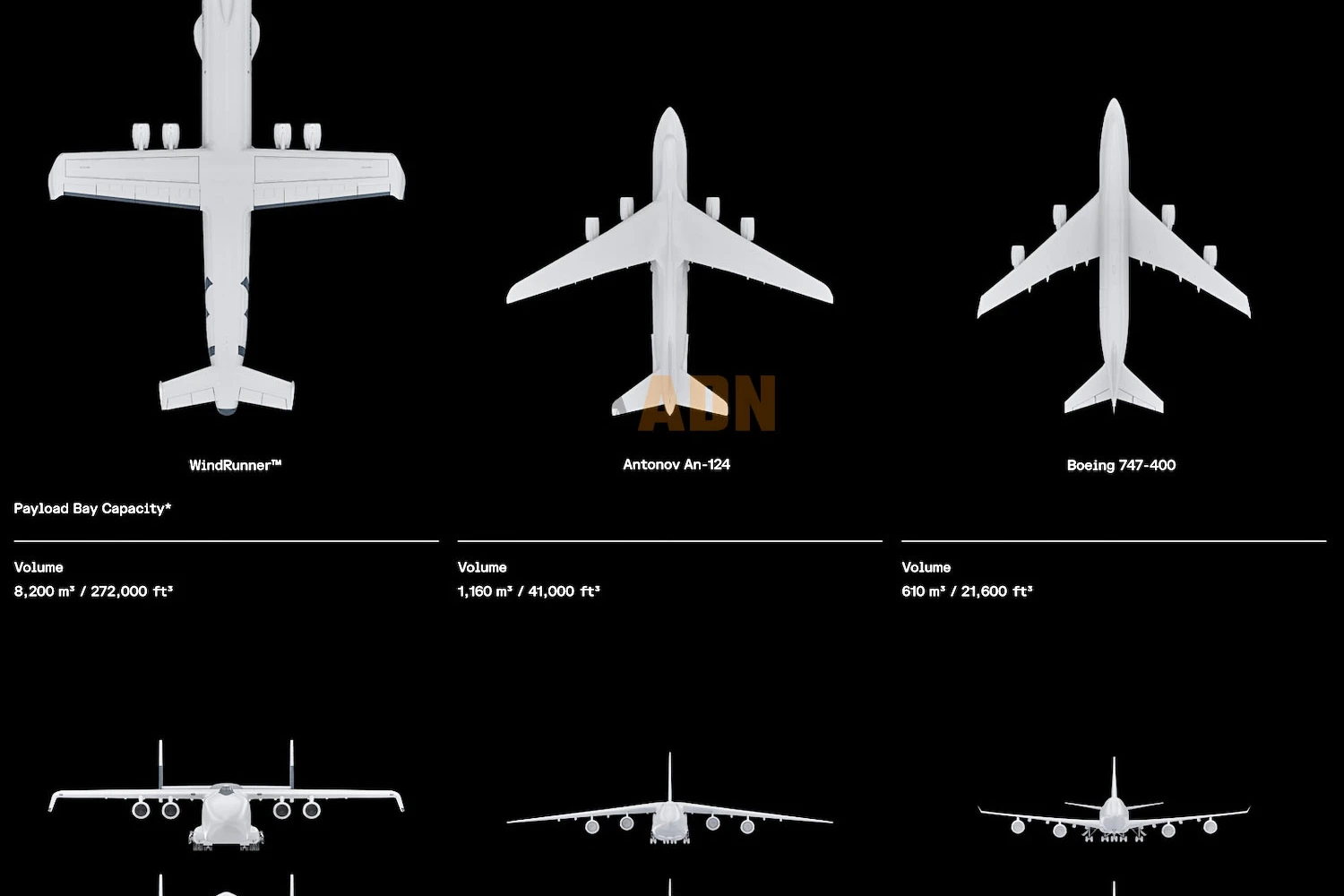
Despite its enormous dimensions, maximum payload is 160,000 lb. (72.6 metric tons), considerably less than the Antonov An-124. The WindRunner instead addresses a different logistical problem: cargo that may not be exceptionally heavy but is simply too large to fit inside existing aircraft.
From concept to industrial program
In an interview with Aviation Week, Radia founder and CEO Mark Lundstrom said the company is now entering the industrialization phase and has around two dozen suppliers under contract.
The supply chain includes established aerospace manufacturers responsible for major sections and systems. Leonardo is assigned the fuselage, Spain’s Aernnova the wing and Aciturri the empennage, while Magnaghi Aerospace will supply the landing gear.
Astronautics has been selected for avionics, while Brazil’s Akaer is responsible for the cabin. More recently, France’s Latecoere joined the program for the electrical wiring interconnection system and the UK’s Stirling Dynamics for flight-control integration.
Radia is also beginning to narrow down where the aircraft will be assembled. Lundstrom told Aviation Week that locations in Southern Europe are among the finalists for the final assembly line, although a U.S. site remains under consideration.
The concentration of major structural suppliers in Italy and Spain could favor Europe. According to the executive, candidate locations are being evaluated based on factors including aerospace workforce availability, seaport access and government incentives.
Radia currently expects the first WindRunner to fly in 2030.
Military market gains importance
Although the WindRunner originated as a solution for the wind-energy industry, defense has gradually become a significant part of Radia’s business case.
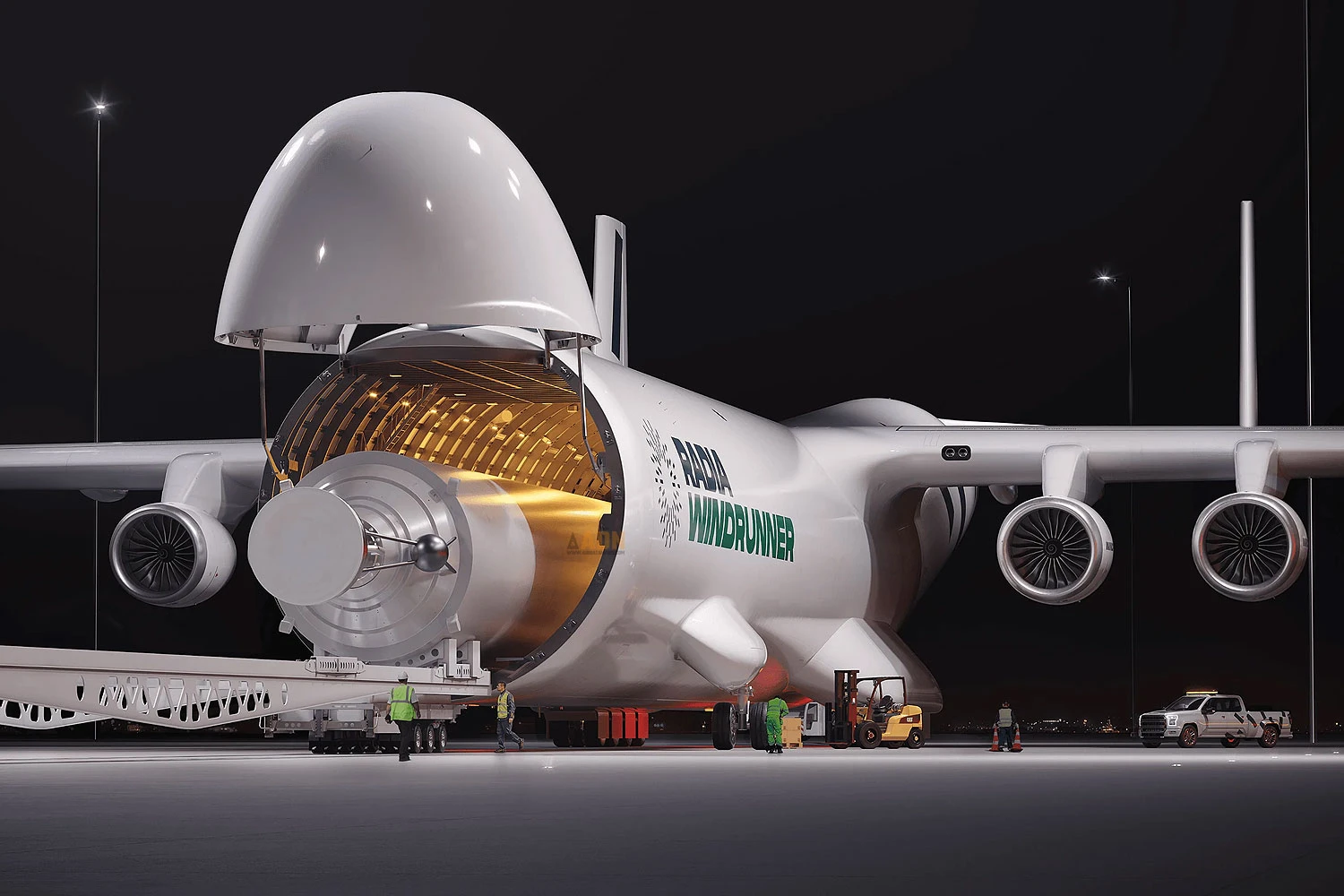
The company has developed a military configuration called C-242, a designation derived from the aircraft’s 242,000-ft³ internal volume. Its unusually large cargo hold could allow equipment to be transported with much less disassembly than required by existing strategic airlifters.
Radia says the aircraft could carry six Boeing CH-47 helicopters or four Lockheed Martin F-16 fighters over approximately 1,100 nm without requiring them to be substantially dismantled.
The company has already established a relationship with the U.S. military. In 2025, Radia and U.S. Transportation Command signed a Cooperative Research and Development Agreement to evaluate potential defense applications for the WindRunner.
One option being studied would not necessarily require the U.S. Air Force to own the aircraft. Commercially operated WindRunners could provide additional military capacity when required, following a concept similar to the Civil Reserve Air Fleet, under which civilian airline aircraft can supplement military transport capacity.
Radia is also offering direct aircraft sales and says it wants the C-242 available for service in the early 2030s.
A different answer from NGAL
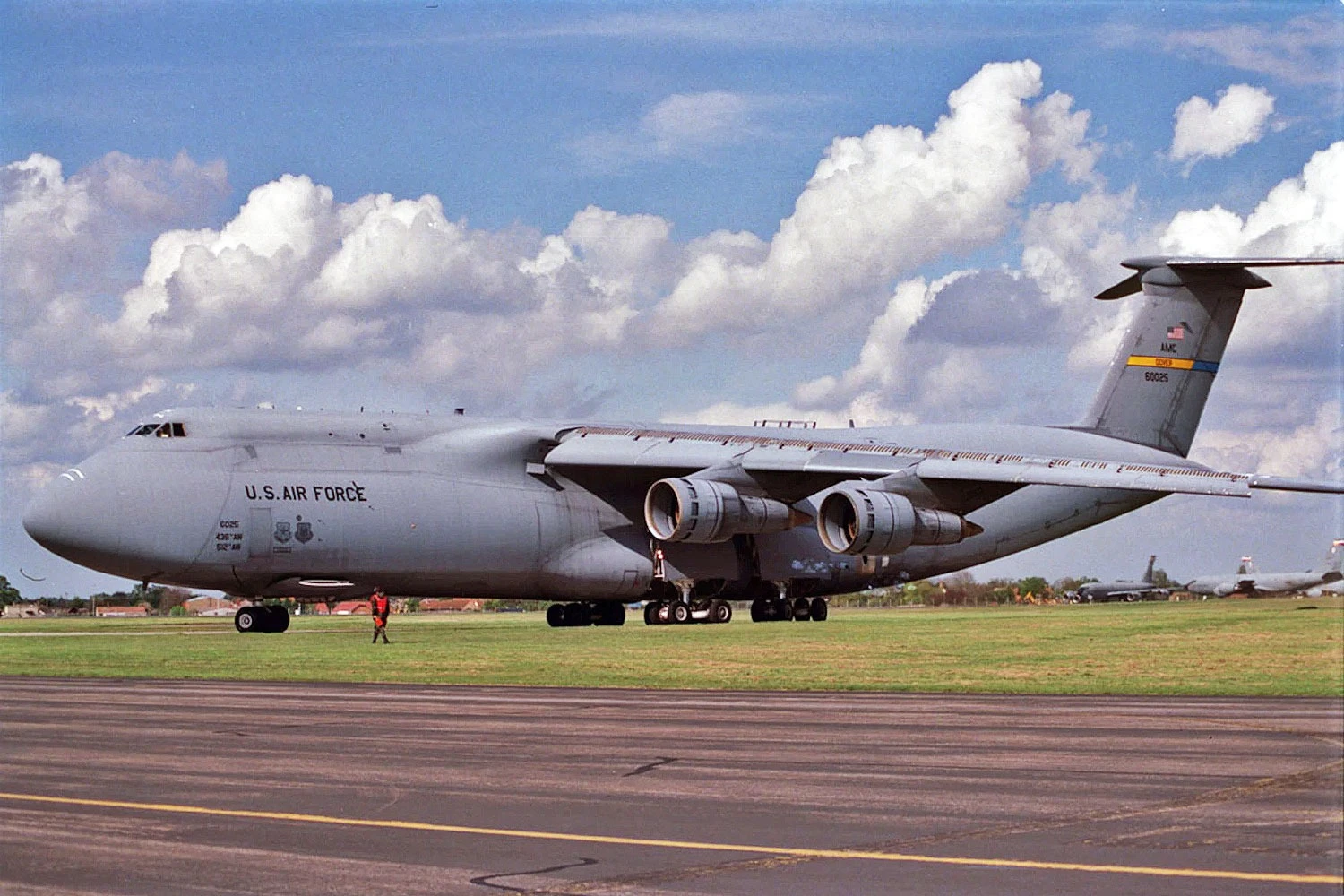
The timing coincides with the U.S. Air Force beginning to define its Next Generation Airlift program, or NGAL, which is intended to eventually supplement and replace the Lockheed Martin C-5M Super Galaxy and Boeing C-17A Globemaster III.
The Air Force issued a request for information in June to assess what industry could offer. This remains an early market-research effort rather than a formal competition, with definitive program milestones and quantities still to be established.
Two of the initial constraints reveal that the WindRunner, in its current form, is not a direct NGAL candidate.
The Air Force requires proposed NGAL concepts to have a wingspan of less than 223 ft. (68 m), primarily because of limitations imposed by existing taxiways, ramps and hangars around the world. It also wants the aircraft to carry at least 160,000 lb. over 2,500 nm without refueling.
The WindRunner matches the 160,000-lb. payload figure but has a 261-ft. wingspan and is designed for a range of about 1,200 nm with maximum payload.
Rather than presenting the C-242 as the eventual NGAL, Radia sees an opportunity to provide additional capacity before the new Air Force aircraft becomes available.
The current planning cited by Aviation Week calls for NGAL production to potentially begin around 2038 and initial operational capability to follow in 2041. The C-5 is expected to leave service in the late 2040s, while the C-17 could remain operational through 2075.
Radia believes this creates an opportunity during the 2030s for the C-242 to supplement existing strategic airlift fleets while the next-generation aircraft is still being developed.
Volume rather than weight
The WindRunner would occupy a very different niche from existing military transports.
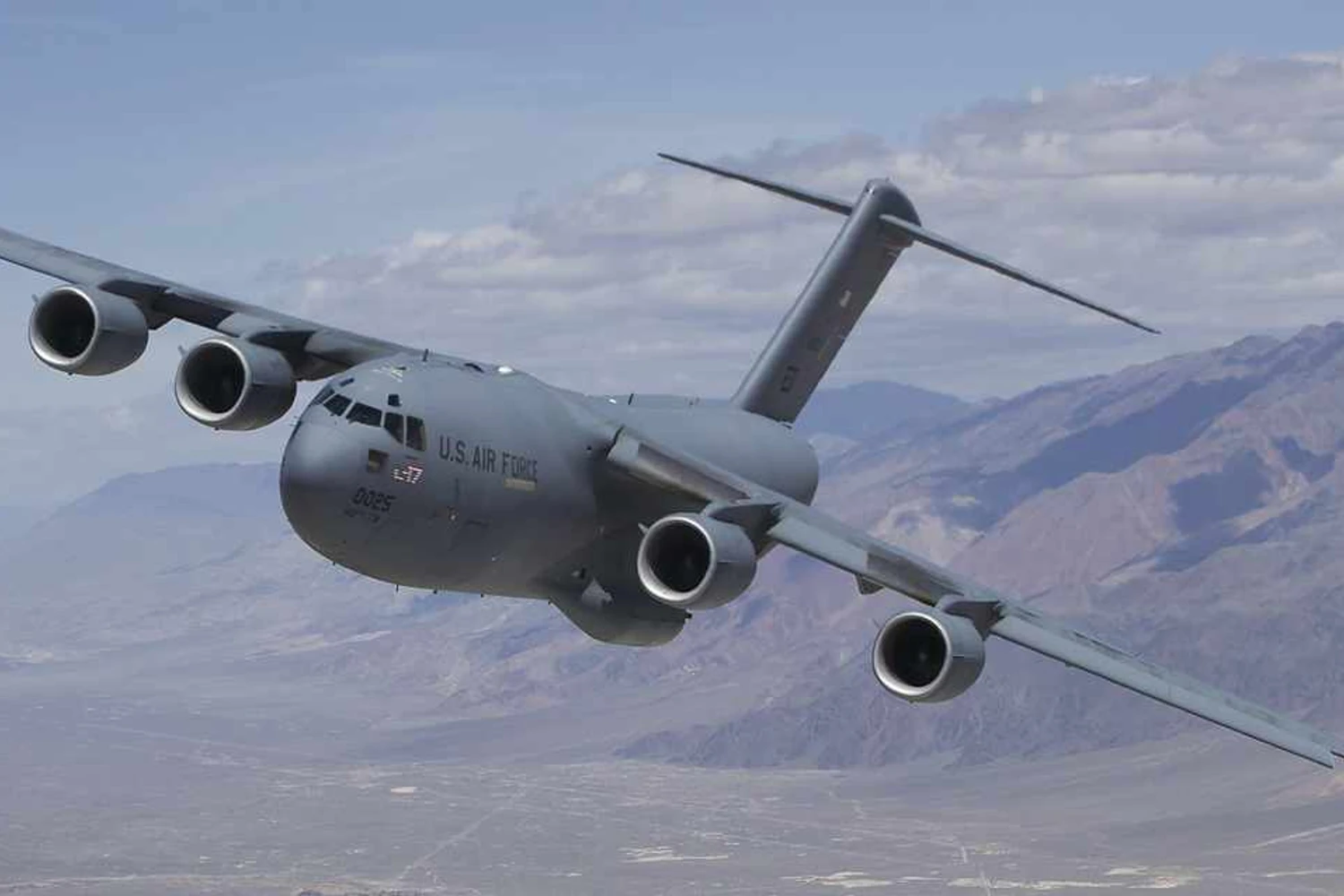
Its 33-ft. (10-m) maximum internal width compares with approximately 21 ft. for the An-124 and 13 ft. for the C-17 and Airbus A400M. Radia says its internal volume is around seven times that of a C-5 despite carrying a payload closer to that of a C-17.
The aircraft is also being designed to operate from runways around 6,000 ft. (1,830 m) long and from relatively austere surfaces, an unusual capability for an aircraft of its size.
Four commercially available turbofans in the approximately 55,000-lb.-thrust class are planned, although Radia has not yet announced an engine selection. Cruise speed is expected to be around Mach 0.6.
Defense could help make the numbers work
Building a clean-sheet aircraft of this size for a highly specialized commercial market remains the largest question surrounding the program.
Outsize cargo can command substantially higher yields than conventional air freight, but the number of missions requiring an aircraft with the WindRunner’s extraordinary dimensions is limited.
That makes military demand potentially important to the economics of the program.
Tom Crabtree, managing director of Transport Research Advisory, told Aviation Week that securing business from U.S. Air Mobility Command or a similar European coalition could be crucial for Radia. Unlike conventional freighter programs derived from passenger aircraft, the WindRunner does not have a larger commercial passenger fleet over which development and support costs can be spread.
Radia is meanwhile pursuing opportunities on both sides of the Atlantic. Its growing European industrial footprint coincides with efforts by NATO countries to expand strategic airlift capacity, while aging aircraft and the limited availability of An-124s have reduced the number of very large transports accessible to Western operators.
The company is betting that a combination of commercial outsize cargo and military demand can support an aircraft whose defining characteristic is not how much weight it can lift, but what it can carry that no other available aircraft can accommodate.
