


6K Energy, a U.S. producer of advanced battery materials, and CRG Defense, a U.S. manufacturer of advanced aerospace and defense systems, have announced a seven-year collaboration intended to support a domestic battery supply chain for mission-critical defense applications. The agreement establishes a basis for long-term cooperation and domestic sourcing of high-performance cathode active materials to power next-generation, American-made battery cells and packs.
Both sides described the collaboration as a way to strengthen U.S.-based battery material production and reduce reliance on foreign supply chains. The agreement is also presented as a foundation for future expansion and deeper integration across the domestic battery ecosystem. In the release, the partners said the arrangement is meant to create demand signals for other battery component suppliers expanding capacity in the United States.
Under the agreement structure, 6K Energy will supply CRG Defense with single-crystal NMC811 cathode material from its facility in North Andover, Massachusetts. Additional capacity is expected to come online in late 2026. Once 6K Energy’s PlusCAM facility in Jackson, Tennessee, begins operations in early 2028, that site is expected to meet projected growth requirements. The seven-year agreement also includes a structured Quarterly Purchase Plan intended to provide a consistent supply for mission-critical programs.
Timing is central to the deal. The companies linked the collaboration to the FCC’s December 2025 ban on foreign-produced unmanned aerial system critical components and to Section 842 of the FY 2026 NDAA, which, according to the release, will prohibit the Department of War from procuring batteries from foreign entities of concern. Use of U.S.-produced cathode active materials is expected to support fully NDAA-compliant, high-energy battery solutions for applications including next-generation unmanned aerial systems. “The shift to domestic sourcing for critical UAS components represents both a challenge and an opportunity for the defense industrial base,” said Patrick Hood, CEO of CRG Defense. “By partnering with 6K Energy, we are ensuring current and future access to the domestic materials necessary to supply our customers with secure energy solutions for critical defense applications. Our drone platforms will now be powered by technology that is truly American-made from the chemistry up.”

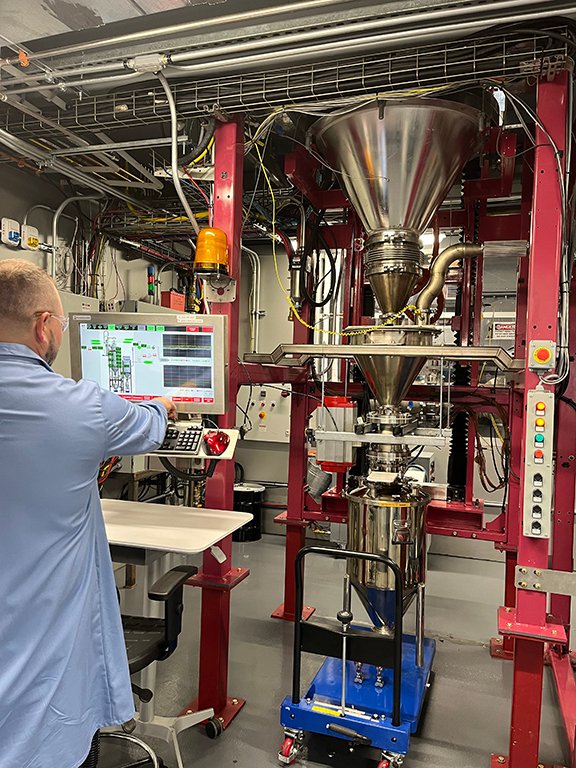
Saurabh Ullal, President of 6K Energy, said the agreement reflects a longer-term effort to rebuild battery production capacity in the United States. “Rebuilding a resilient U.S. battery supply chain requires both early commitment and long-term partnerships,” he said. “This agreement marks the beginning of a strategic relationship with CRG Defense as we invest in the infrastructure and technology required to remove reliance on foreign sources. Our PlusCAM facility is designed to deliver sustainable, battery-cathode material at scale for the most demanding defense applications.” Future supply under the agreement will be supported by UniMelt, a production-scale microwave plasma process for advanced materials manufacturing.
6K builds on earlier materials and defense work
Part of what makes the CRG Defense agreement more consequential is that 6K has already been using its UniMelt platform in a separate long-term supply arrangement tied to advanced manufacturing feedstock. In that earlier deal, Siemens Energy, which operates additive manufacturing facilities that generate nickel alloy powder during production, agreed to supply spent nickel-based superalloy powder to 6K Additive for processing through UniMelt. Nearly 20 tons of nickel superalloy powder had already been processed at the time of the announcement, with resulting material supplied into the additive manufacturing market. That prior work matters here because it shows UniMelt being used on industrial feedstock in an established supply relationship, rather than being presented only as a future production concept.
Defense-linked battery materials work was also underway before the CRG Defense deal. 6K Energy received $1.9 million under the U.S. Defense Logistics Agency’s Battery Network Program III for a 12-month research and development effort focused on lithium-ion battery materials for defense use. That program centered on single-crystal NMC721 cathode material, including scaled synthesis through UniMelt, post-processing optimization, and electrochemical validation with a U.S.-based lithium-ion cell manufacturer. According to the company, the work was designed around battery cells manufactured entirely in the United States for defense applications. In practical terms, that earlier award positioned 6K Energy’s battery materials work within an existing domestic defense supply-chain framework before this seven-year commercial agreement was announced.

3D Printing Industry is inviting speakers for its 2026 Additive Manufacturing Applications (AMA) series, covering Energy, Healthcare, Automotive and Mobility, Aerospace, Space and Defense, and Software. Each online event focuses on real production deployments, qualification, and supply chain integration. Practitioners interested in contributing can complete the call for speakers form here.
To stay up to date with the latest 3D printing news, don’t forget to subscribe to the 3D Printing Industry newsletter or follow us on LinkedIn.
Explore the full Future of 3D Printing and Executive Survey series from 3D Printing Industry, featuring perspectives from CEOs, engineers, and industry leaders on the industrialization of additive manufacturing, 3D printing industry trends 2026, qualification, supply chains, and additive manufacturing industry analysis.
Featured photo shows 6K Energy and CRG Defense to collaborate on powering next-generation, American-made battery cells and packs. Photo via 6K Energy.
