


Anyone who’s spent half an hour sticking reflective dots across a car hood before firing a single scan line knows the frustration. On a vintage Porsche awaiting restoration, those markers can’t touch original paint. Museum artifacts prohibit them entirely. The markers aren’t the point of the job, but until now, there’s been no way around them.
SHINING 3D thinks that’s ready to change. Their new EinScan Trak 3D Tracking System is built around the idea that users shouldn’t need to touch the object before scanning it, or need two separate rigs to capture both the big picture and the small details.
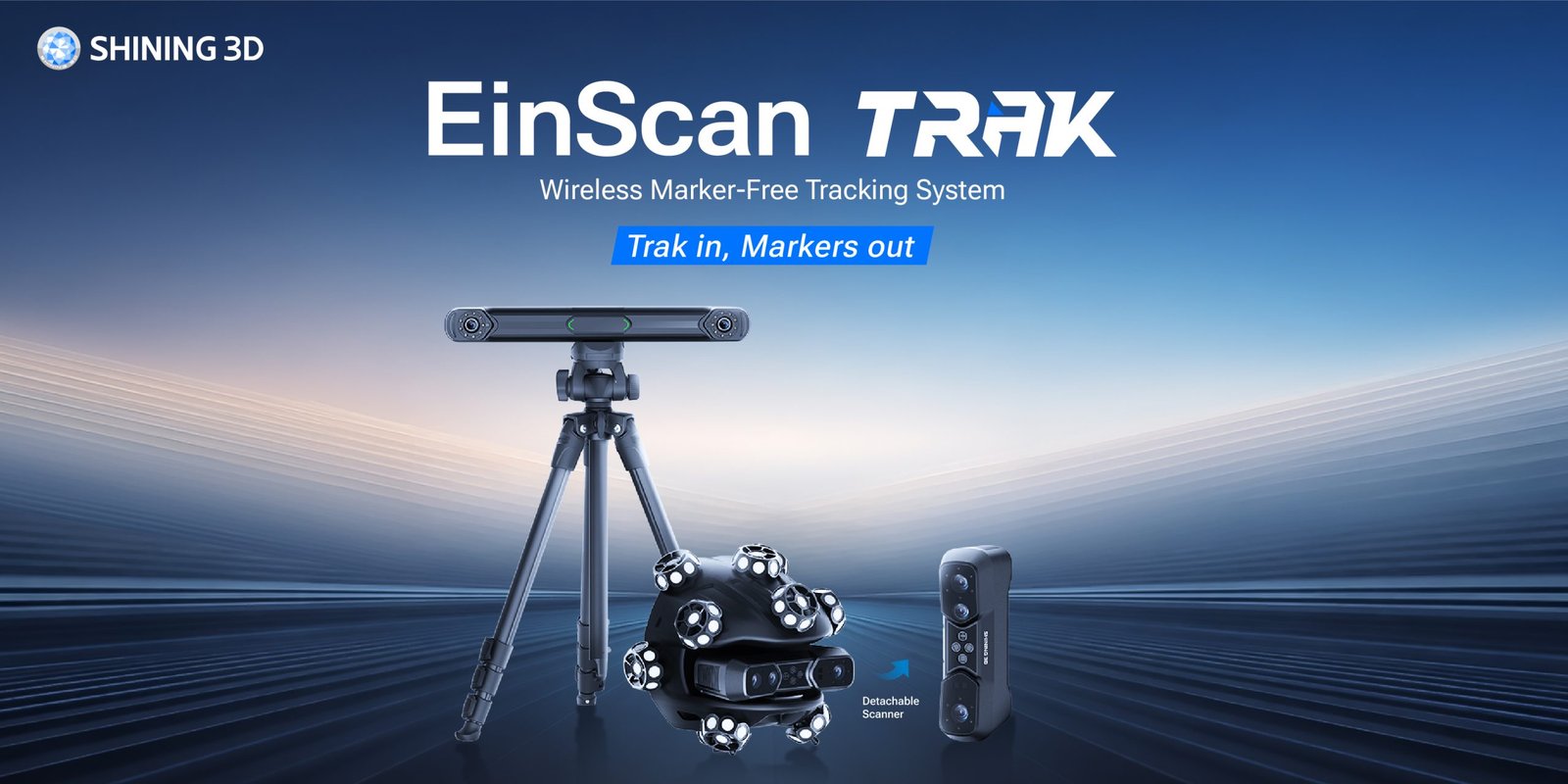
The way it eliminates markers is surprisingly straightforward. The system has two components including an optical tracker, essentially a camera unit on a tripod, and a spherical scanner module which integrates a detachable handheld scanner that one moves across the object’s surface.
The tracker watches the scanner, not the object, reading retroreflective markers built into the scanner housing to determine its position in space. Because the tracker is following the scanner and not the object, there’s nothing to stick on the object itself.
Marker-Free Scanning Without the Setup
The need for separate equipment for large-area scanning and close-up detail gets a similarly practical solution. The spherical scanner holds a detachable handheld unit inside it. Pull it out, and users have an independent wireless handheld laser scanner that requires no tracker setup.
This is the mode for crawling into wheel wells, scanning deep cavities, or capturing small mechanical parts on a bench. Marker-free scanning still works here, though differently, using surface geometry for alignment. For uniform or featureless objects, traditional markers remain an option.
What makes this genuinely useful in practice is that both modes feed into a single project file. Scan a car body in tracking mode, detach the handheld unit, capture the intake manifold in detail, and merge everything without switching software or re-registering datasets. Large-object scanning has traditionally meant committing to one workflow and living with its limitations, so the ability to move between scales inside a single project group is where the real time savings live.

The laser system reinforces that versatility with three projection modes. Crossed laser lines, 19 pairs, cover surface area fast and serve as the default for broad scanning. Seven parallel laser lines trade speed for sharper edge definition on mechanical parts where tolerances matter.
A single laser line reaches into deep holes, narrow channels, and internal structures. That last mode sounds minor until users are staring at a mesh with a perfectly captured exterior and a blank void where the exhaust port should be.
Speed and resolution back up those modes with numbers that matter for professional work. The scanner captures up to 2,630,000 points per second at resolutions up to 0.05mm. During scanning, users can switch between resolution settings and apply Local Resolution to specific areas that require greater detail, allowing them to balance scanning speed and detail within the same project. A 5MP texture camera captures color alongside geometry, which is worth noting because optical tracking systems have historically treated color as an afterthought.
For reverse engineering, color is irrelevant. For cultural heritage, museum digitization, or AR/VR asset creation, it’s essential.
Speed and Resolution for Professional Work
All of this runs wirelessly, which is where the field-readiness argument comes together. Wi-Fi 6 through a dedicated local network, auto-pairing at startup, with a working range of four meters from the tracker.
Battery life is rated at five and a half hours in tracking mode and three and a half in handheld mode, with hot-swappable batteries so users never shut down to swap. The body is carbon fiber, built for transport.
The four-meter wireless range could sound limiting for large objects, but a feature called Hybrid Leapfrog addresses that directly. Users reposition the tracker mid-scan without losing tracking continuity, each station requires four markers for identification to establish the next position and maintain scan continuity.
The system is also rated for outdoor use up to 110,000 lux and handles difficult surfaces including gloss black, bare metal, and reflective finishes without spray coating.

On the software side, two companion packages round out the workflow. EXMeasure handles dimensional measurement, covering GD&T checks, flatness and parallelism measurements, caliper simulation, and color map comparisons.
EXModel handles reverse engineering, from mesh cleanup and auto-surfacing to CAD-ready geometry export, and requires a separate purchase. Purchasing EinScan Trak includes a one-year EXMeasure license.
So who actually needs this? The people running two or three separate setups to cover large-area capture and fine-detail scanning, burning prep time on markers between every job. Automotive aftermarket shops digitizing body panels and assemblies.
Heritage conservation teams who can’t modify what they’re scanning. Engineering firms doing reverse engineering in the field. For users focused exclusively on small-part scanning, a single handheld scanner may already be sufficient.
Marker-free tracking, a detachable handheld scanner, three laser modes, and wireless operation in a single carbon fiber system. For professionals tired of prepping surfaces before scanning them and hauling separate rigs for different scales of work, the EinScan Trak is SHINING 3D’s answer to both problems at once.
Technical specifications and pricing
For pricing details, interested readers can contact SHINING 3D.

3D Printing Industry is inviting speakers for its 2026 Additive Manufacturing Applications (AMA) series, covering Energy, Healthcare, Automotive and Mobility, Aerospace, Space and Defense, and Software. Each online event focuses on real production deployments, qualification, and supply chain integration. Practitioners interested in contributing can complete the call for speakers form here.
To stay up to date with the latest 3D printing news, don’t forget to subscribe to the 3D Printing Industry newsletter or follow us on LinkedIn.
Explore the full Future of 3D Printing and Executive Survey series from 3D Printing Industry, featuring perspectives from CEOs, engineers, and industry leaders on the industrialization of additive manufacturing, 3D printing industry trends 2026, qualification, supply chains, and additive manufacturing industry analysis.
Featured image shows the SHINING 3D EinScan Trak 3D Scanner. Image via SHINING 3D.
