


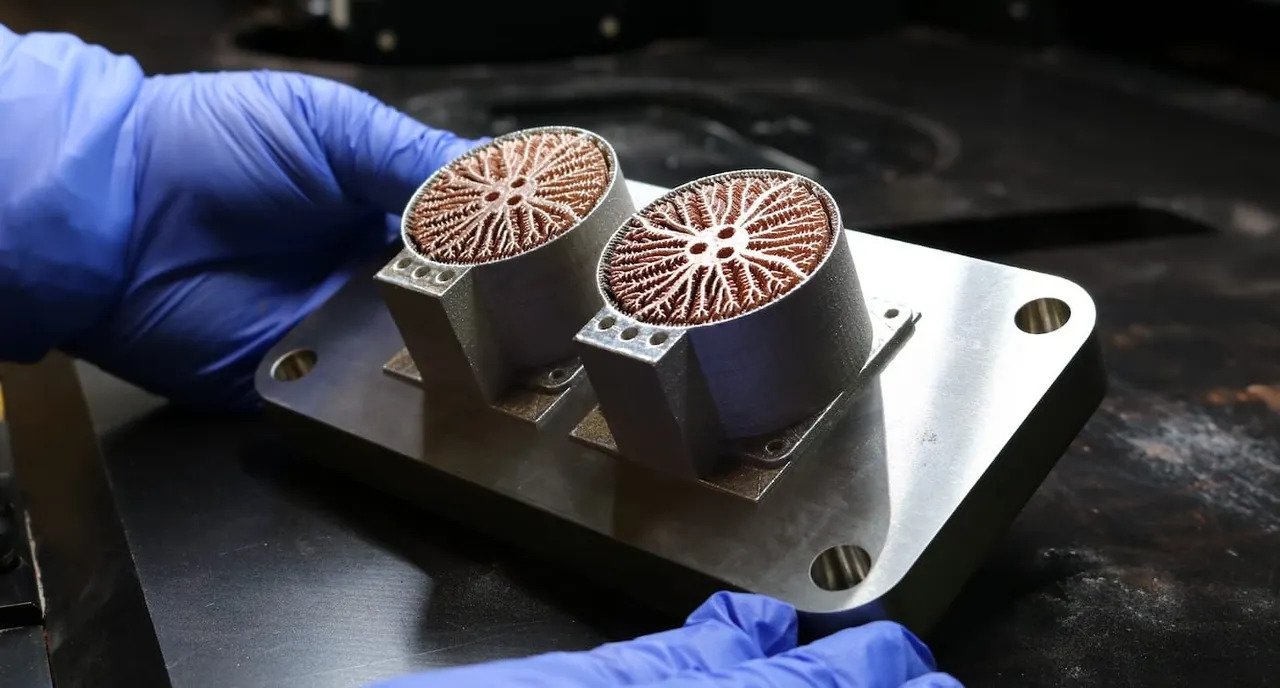
The University of Turku in Finland has added a multi-material recoater to its metal 3D printing system, allowing researchers to deposit different powders from three separate drums within a single layer. The setup will be used to study parts that combine several metals, a capability the university links to future plasma-facing components for fusion energy and aerospace propulsion.
Combining several metals in one printed part could allow a component to withstand heat or wear in one area while transferring heat or providing structural support in another. The new equipment offers a way to test how such parts can be designed and produced with metal additive manufacturing (metal AM).
The hardware is a Schaeffler Aerosint SPD2.1-B5 recoater, now integrated into the university’s Aconity MIDI+ printer. Funding came through AM4Plasma, a EUREKA Network project coordinated by the University of Turku and supported in Finland through Business Finland’s CoInnovation program.
How the Recoater Places Different Metals
In conventional single-material laser powder bed fusion (LPBF) , a recoater spreads one powder across the build area and a laser melts it according to a digital design, building the part layer by layer. The Aerosint unit uses three separate powder-delivery drums to lay down different powders in selected areas of a layer before laser processing. Repeating this process across successive layers makes it possible to produce parts in which the material changes by location.
“Multi-material manufacturing allows us to ask which material is needed in each region of a component and how those materials can work together. This infrastructure gives us a platform to investigate those questions, develop our expertise, and explore new applications with industrial partners,” said Associate Professor Ashish Ganvir, principal investigator of AM4Plasma, a project developing new plasma generator hardware.
Bonding, Defects, and Interface Quality
Placing several powders side by side raises questions about how each one reacts to the laser, whether dependable bonds can form between neighboring materials, and how a given arrangement of materials affects whether a part can be manufactured. Research areas include laser and material interaction, melting and solidification, bonding at material boundaries, cracking and other defects, and the link between processing conditions and local properties.
The university notes that selective powder deposition does not by itself yield a reliable multi-material part. Compatible material pairings, suitable process settings, and sound interfaces are also needed, and defining those relationships will be central to the research.
As an example, the university describes a component with one region designed to tolerate intense thermal exposure and another that conducts heat toward cooling channels. Plasma-facing parts of this kind could be used in future fusion energy and aerospace propulsion systems.
Applications Beyond Plasma Hardware
AM4Plasma provides an initial application for the equipment, focusing on multi-material components for plasma generator technology.
“The infrastructure’s longer-term significance extends beyond this application. It provides a platform for future studies of material combinations, manufacturing processes and multifunctional component design,” said Ganvir. The system will also be used for researcher training.
Getting Dissimilar Metals to Bond in Multi-Material Powder Bed Fusion
The University of Turku can now place different powders within a layer, but the university says the metal pairings, process settings and interface conditions needed for a sound part still have to be established. Two recent efforts using multi-metal LPBF have tackled that question.
At the University of Nottingham’s Centre for Additive Manufacturing (CfAM), researchers studied interfaces between IN718 and GRCop-42, a copper alloy developed by NASA, for parts such as rocket combustion chambers. They used an Aconity MIDI+ printer with a Schaeffler Aerosint recoater, a hardware pairing comparable to Turku’s. Deposition order and recoating direction affected defects and alloy mixing at the boundary, and the authors say mechanical testing is still needed.
CfAM also leads DIADEM, a program with the UK Atomic Energy Authority that aims to grade the transition between tungsten and copper in fusion plasma-facing components, where conventional joining often leaves cracks, voids or residual stress. Tungsten handles heat while copper carries it away, a split that mirrors the heat-facing and heat-conducting regions in Turku’s example component.
Turku’s new equipment adds another research group working on the step that follows powder placement: making the joint between metals hold up.
To stay up to date with the latest 3D printing news, don’t forget to subscribe to the 3D Printing Industry newsletter or follow us on LinkedIn.
Explore the full Future of 3D Printing and Executive Survey series from 3D Printing Industry, featuring perspectives from CEOs, engineers, and industry leaders on the industrialization of additive manufacturing, 3D printing industry trends 2026, qualification, supply chains, and additive manufacturing industry analysis.
Featured image shows Model parts made from different metal alloys, printed by Schaeffler Aerosint with the new multi-material equipment. Photo via AM4Plasma research group.
