


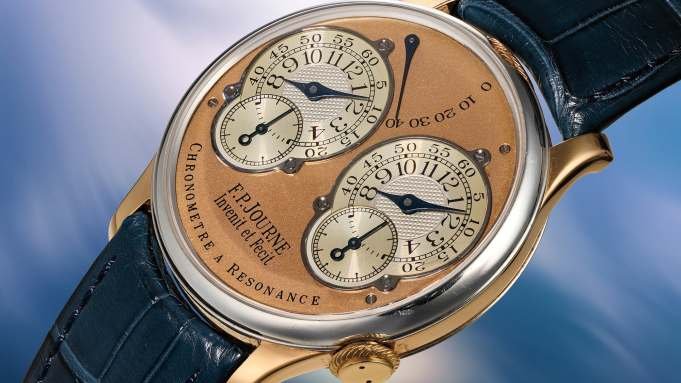
If there was any doubt that François-Paul Journe is the hottest independent watchmaker alive, he is now firmly cemented as king after this weekend’s Phillips New York: Watch Auction XIV.
His F.P. Journe Chronomètre à Résonance “Souscription, No. 007” sold for an astonishing $13.92 million, becoming not only the most expensive watch ever sold by the maker, but the highest price achieved for any watch by an independent watchmaker and any 21st-century watch offered at a commercial auction. It hammered home at the jaw-dropping price after only nine minutes of bidding.
For reference, the previous record for an indie at auction belonged to fellow watchmaking legend Philippe Dufour when his Grande & Petite Sonnerie Wristwatch sold for $5.7 million at Christie’s in 2023. (However, before that in 2021, another Dufour Grande & Petite Sonnerie sold privately for $7.63 million at A Collected Man.)
Introduced in 2000, the Chronomètre à Résonance translated one of horology’s oldest intellectual curiosities into a serially produced wristwatch. The phenomenon of resonance had fascinated watchmakers for centuries. In the 18th century, Christiaan Huygens observed that two pendulum clocks mounted on the same support could synchronize through tiny vibrations. Abraham-Louis Breguet later explored the concept in pocket watches. Journe, however, managed something his predecessors had never achieved on this scale: adapting the principle for the wrist.
F.P. Journe Chronomètre à Résonance Souscription No. 007
The Résonance employed two independent balance wheels and escapements positioned close enough together to influence one another, settling into a shared rhythm. The result, at least theoretically, was improved chronometric stability. Yet its allure has always extended beyond precision. It’s the kind of thing die-hard watch collectors love: an outwardly beautiful piece in design with inner mechanics and innovation that required years of experimentation devoted to solving a problem few people even knew existed.
This particular example elevates that story further.
Between 1999 and 2000, before Journe became one of the most coveted watchmakers in modern history, he offered 20 early Résonance watches to founding clients through a subscription system, asking them to place deposits that would help finance production of his fledgling manufacture. (A similar technique was once used by his idol, Breguet.) These “Souscription” pieces were, in effect, acts of mutual belief: collectors wagering on a watchmaker who had yet to prove himself on the global stage. The practice has now practically become standard in certain realms of indie watchmaking.
No. 007 is among the rarest of them all. One of just twenty Souscription Résonances produced, it is believed to be one of only two examples cased in platinum and pink gold with a matching pink gold dial. Fresh to the market and appearing publicly for the first time, it possesses incredible provenance.
Therefore, it was no surprise that it would soar above its top estimate, but in the end, it skyrocketed. Nearly $14 million for a watch completed at the dawn of the millennium would have sounded absurd more than a decade ago. But speak to representatives from the brand and they’ll tell you they aren’t always excited by these headlining results. “The prices are just stupid,” Pierre Halimi, F.P. Journe’s longtime manager of the Americas told Robb Report last November during a talk during Miami Art Basel. “They’re just way too high and we’re not happy about this.” He was referring both to the danger of being too hot one minute and out-of-favor the next but more than that it’s what it attracts. “It brings a breed of collectors or people that buy it for assets, and assets only, and this is the danger because these people are more interested in the price than the value.”
In the end, the most remarkable thing about Souscription No. 007 is not what it sold for. It’s an astounding piece of modern watchmaking history in which twenty collectors were willing to risk backing a brilliant, uncompromising watchmaker with little more than a promise.
Twenty-six years later, that trust has paid off in spades.

