


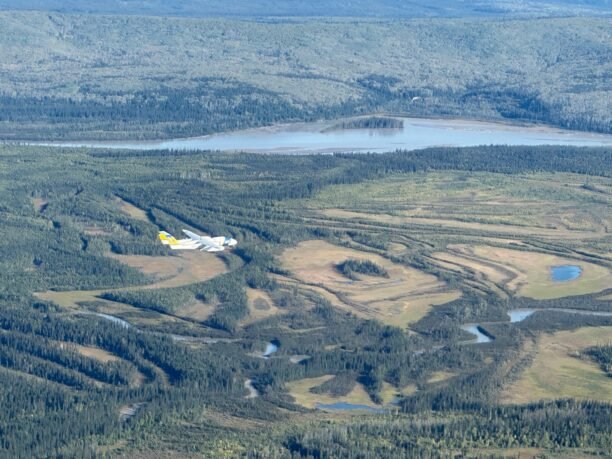
A Windracers ULTRA operated by the Alaska Center for Unmanned Aircraft Systems Integration carried chilled human blood samples on an 8-hour, 47-minute round trip from Nenana, testing whether long-range drones can move biological samples without degrading them.
Alaska’s drone research program completed a 1,000-kilometer (621-mile) test flight carrying human blood samples for the International Testing Agency, the organization that investigates doping by athletes at the Olympics and other major competitions. The flight lasted 8 hours and 47 minutes. It was conducted by the Alaska Center for Unmanned Aircraft Systems Integration (ACUASI), part of the University of Alaska Fairbanks Geophysical Institute, and began and ended at Nenana Municipal Airport on August 19, 2026.
Staff from the Interior Region EMS Council collected samples from volunteers the previous day at UAF, and each volunteer provided two samples so analysts could compare conditions before and after transport. ACUASI supplied the flight platform and aviation expertise. Sysmex America, the U.S. subsidiary of Japan-based medical diagnostics company Sysmex Corp., provided diagnostic equipment, while the Institute of Doping Analysis and Sports Biochemistry in Dresden, Germany handled sample analysis.
“The competency of ACUASI pilots is truly outstanding,” said Cathy Cahill, director of ACUASI. “The fact that they know how to do this and can go out, get set up and do something that is time-sensitive like this is significant. If it’s an emergency, you don’t want to trust it to an amateur.”
Windracers ULTRA platform and flight profile
The ITA contracted with ACUASI for the test, and drone manufacturer Windracers brought the two organizations together. Windracers builds the ULTRA aircraft used on the flight. ACUASI owns two of the twin-engine airframes, which carry a 31-foot (9.4-meter) wingspan, a range of roughly 600 miles (966 kilometers), a 200-pound (91-kilogram) cargo capacity and three cargo drop doors. Notably, they can operate from dirt, grass, ice or tarmac.
Timing drove the entire operation. The sequence began with the blood draw and continued through cold storage, labeling, ground transport from Fairbanks to Nenana, aircraft preparation, cargo loading and the flight itself. Samples carried no personally identifying information and were not evaluated for doping or medical conditions. Even so, chain of custody had to hold throughout.
Drone blood sample delivery for anti-doping enforcement
“Athletes want something efficient, something they can trust,” said Neil Robinson, head of the ITA Science and Medical Department. “Samples are in sealed boxes and loaded in the drone. Everything is documented, and we can track the aircraft to demonstrate that it didn’t land in a field so someone could take the samples.”
The agency ran its first drone-delivery testing in 2022 in Doha, Qatar with a Swiss drone company. That work, conducted with the Qatari anti-doping laboratory, consisted of three quadcopter flights covering distances up to 20 kilometers (12 miles), and each flight cut travel time by roughly half against ground delivery. By comparison, the Alaska test let the ITA evaluate transport across a far greater distance.
“There are not many drones like this in the world with this cargo capacity,” Robinson said. “These drones are of great interest to us because we can fly much longer distances.” He expects wider use of unmanned aircraft for medical samples, since they can cost less than crewed aircraft and let anti-doping officials respond faster. “The interest is to use sport as a model to ship samples. I’m not saying we’re ready today, but I think we’ll be ready tomorrow.”
Rural healthcare applications in Alaska
While the test centered on blood samples, the results could inform medical testing, research and other biological sample transport. Cahill framed the opportunity in terms of remote Alaska communities.
“If we can have nurses go into a community and take samples, send them back for analysis, determine what medications are needed and get that sent back to the community before the nurses leave, that is a huge benefit for getting people the care they need in the location where they are,” Cahill said.
UAF is one of nine FAA-designated unmanned aircraft systems test sites. ACUASI manages and operates the site, which maintains several test locations around the country.
More information is available at ACUASI.
Read More

Ian McNabb is a journalist focusing on drone technology and lifestyle content at Dronelife. He is based between Boston and NH and, when not writing, enjoys hiking and Boston area sports.
