


Welcome to Taste Test, where every week our critic Jonah Flicker explores the most buzzworthy and interesting whiskeys in the world. Check back each Sunday for his latest whiskey review.
I did not expect this to happen. Specifically, I did not anticipate that I would like the new Eagle Rare 30 as much as I did when I got to taste it this week, especially given my mixed feelings about the 25-year-old. But here we are—somehow, despite the odds, Buffalo Trace has managed to release its oldest bourbon to date, and it’s really, really good.
Buffalo Trace first released Eagle Rare 25 in 2023, another very expensive, limited-edition, hotly anticipated bottle from a distillery known for such things . . . but it just didn’t do it for me. I love Eagle Rare, particularly the new 12-year-old bourbon, and the 17-year-old version is always one of my favorites in the annual Antique Collection. The 25, however, felt like a whiskey that spent much too long in a barrel, despite some of that time having been in Buffalo Trace’s climate-controlled experimental Warehouse P (more on that in a moment). It was too bitter, too oaky, and too tannic for my taste.
So when I sat down to taste the 30-year-old, I kind of assumed it would have veered even more heavily in that direction. But that’s thing about whiskey—science and controllable elements are certainly part of the process, but then there’s also the fact that nature just takes its course. That means that sometimes a whiskey that has spent a few more years interacting with wood than a younger version comes out the other side softer and more delicate than you might expect. And that is indeed the case here.
Eagle Rare 30 was initially matured in Buffalo Trace’s regular warehouses for a period of time, where it was subject to the extreme shifts in temperature that define Kentucky’s seasons, before going into Warehouse P. The distillery did not say exactly how long it spent there, but that it slowed down the interaction between wood and whiskey by controlling temperature and humidity to simulate a climate you’re more likely to find in Scotland, Ireland, or even northern Japan.
The result is a stunner of an ultra-aged bourbon. I’m often not a fan of American whiskey this old, with expressions from brands like Blade and Bow, Redemption, and I.W. Harper that have broken the 30-year mark falling well short of drinkability. There are, however, some exceptions—Michter’s 25 and Celebration Sour Mash (the latter is a blend of ages) push this boundary successfully. Add this bourbon to that list. Eagle Rare 30 is way less earthy than its younger counterpart, something that I couldn’t get past with the 25-year-old—notes of wet leather and barrel char dominated the palate for me. The 30-year is totally different, with softer notes of fruit, spice, vanilla, tobacco, leather, and toasted wood all in the mix, but never careening into the harsh, bitter, tannic notes that you might expect. If I had one quibble, it’s that I would have wanted to try it a bit stronger than the 101 at which it was bottled, but that’s a small detail because 101 is still plenty high (and I don’t know what the cask strength actually was).
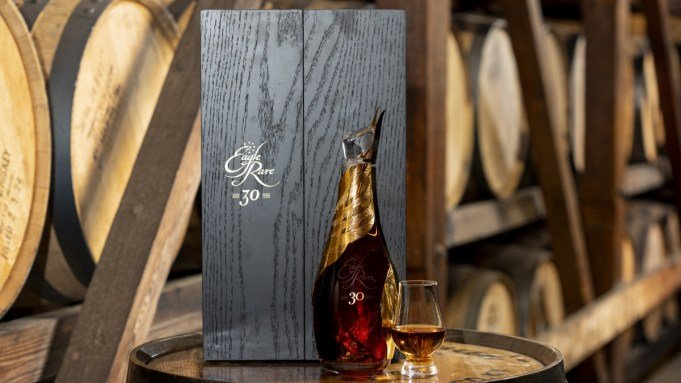
Of course, this is an aspirational bottle for most. The whiskey comes in a hand-blown decanter inside a bespoke display box, and it’s priced at $12,500. That means it’s going to sell for a lot more than that once it hits the secondary market, because that’s just how things go. You can also find an entire collection of Eagle Rare, including the 30, up for auction at Bonhams from April 24 to May 8. There’s talk of a 15-year-old release in the future, and I’m sure that will be very good. There’s also likely to be an even older release somewhere down the road, but I’m not so sure about that one. Hopefully I’ll get to try it when it drops and report back. In the meantime, if you have the money to spend and the time to hunt, I highly recommend giving this ultra-expensive, ultra-aged bourbon a try.
Score: 94
- 100 Worth trading your first born for
- 95 – 99 In the Pantheon: A trophy for the cabinet
- 90 – 94 Great: An excited nod from friends when you pour them a dram
- 85 – 89 Very Good: Delicious enough to buy, but not quite special enough to chase on the secondary market
- 80 – 84 Good: More of your everyday drinker, solid and reliable
- Below 80 It’s Alright: Honestly, we probably won’t waste your time and ours with this
Authors

Jonah Flicker

