


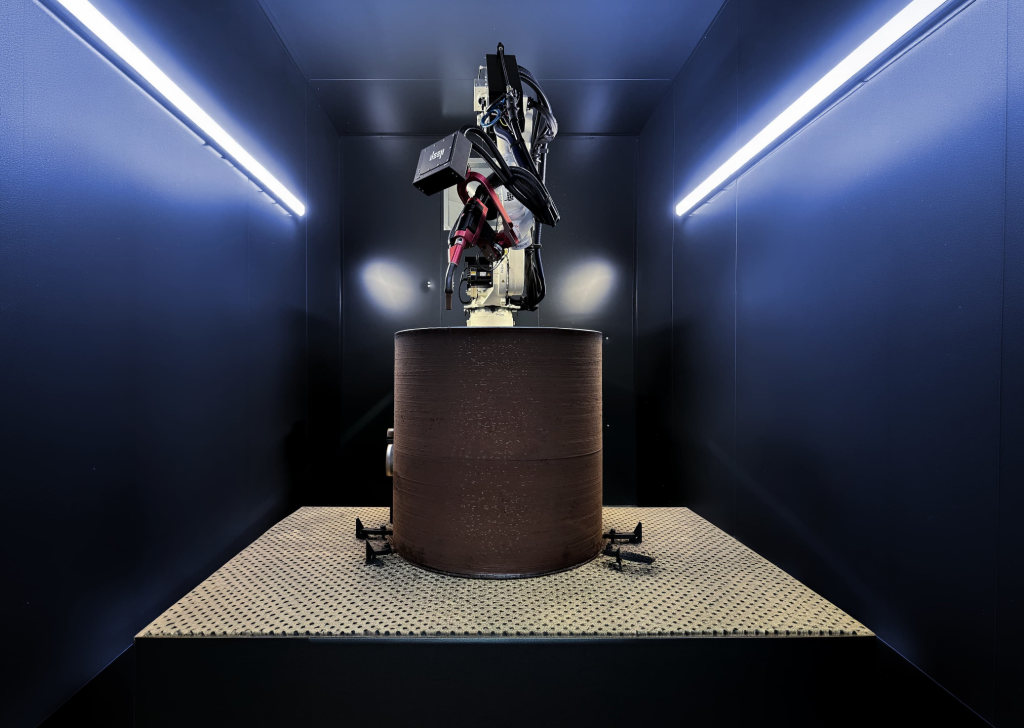
DEEP Manufacturing, a specialist in wire arc additive manufacturing (WAAM) for safety-critical structures, has partnered with Colorado-based Fortius Metals to print a complex, multi-material metal cylinder using large-format metal 3D printing.
Announced on June 4, 2026, the project will combine DEEP’s synchronized multi-robot WAAM system with Fortius’ expertise in simulation, toolpath design, and advanced welding wire. The goal is to show that different alloys can be deposited in a single continuous build with the precision and repeatability needed for industrial production.
WAAM works by melting welding wire with an electric arc, building parts layer by layer. The process is typically used for large metal components. What’s different here is the multi-material approach, using more than one alloy in the same part so different sections can be tailored for different performance requirements.
The companies say the work is intended to push multi-material metal additive manufacturing out of the lab. They will start with test samples and a smaller cylinder before the main print, scheduled for mid-June to early July.
Scaling multi-material WAAM
The collaboration builds on DEEP’s recent work scaling synchronized multi-robot WAAM, which highlighted thermal distortion and toolpath generation as two major barriers to larger, more complex builds. Multi-material deposition also emerged as a key opportunity.
Under the partnership, DEEP Manufacturing will handle large-format printing, multi-robot deposition, and real-time monitoring. Fortius Metals will provide thermal and mechanical simulation, toolpath design, and welding wires engineered for more predictable results.
Together, the companies want to reduce uncertainty around complex metal builds. In large-format metal additive manufacturing, failed prints can waste material, time, and money, especially for safety-critical or high-integrity parts.
Peter Richards, CEO of DEEP Manufacturing, said multi-material manufacturing could transform industries that rely on parts built for demanding environments.
“But getting there takes more than depositing metal. It takes process knowledge, monitoring and control at scale,” said Richards. “This project is about proving those capabilities can come together to move hard problems closer to production.”
Jeph Ruppert, CEO of Fortius Metals, added: “Working with DEEP Manufacturing lets us apply our modelling and materials expertise to a real, demanding structure.”
Earlier this year, DEEP also announced a $100 million investment in a permanent engineering and development hub in Florida.
From feasibility to production readiness
The question is not whether multi-material metal deposition is possible. It is whether the process can be controlled well enough for repeatable, large-scale production.
Multi-material builds add variables that single-alloy parts do not have. Material transitions, heat input, cooling behavior, distortion, toolpath sequencing, and mechanical performance all have to be managed inside the same build. Those challenges grow as part size increases.
By combining simulation-led planning with synchronized multi-robot deposition and real-time monitoring, DEEP and Fortius are trying to address those constraints before and during the print. The goal is to create a clearer path from technical feasibility to qualified production.
For now, the project is still in demonstration mode. The main cylinder has not yet been completed. The companies plan to share visual updates as the print progresses, with a follow-up announcement expected after completion.
Building on certified WAAM capacity
The Fortius Metals collaboration follows two recent steps in DEEP Manufacturing’s push to move WAAM into regulated production. In October 2025, the company received DNV Approval of Manufacture (AoM) for WAAM production covering pressure vessels, pressure vessels for human occupancy, and hull structures and equipment. DNV’s AoM program evaluates whether a manufacturer can consistently produce materials and products according to specifications and rule requirements. The company says it is one of the few manufacturers globally, and the only one in Europe, with DNV AoM for WAAM production covering pressure vessels of that kind.
DEEP has also expanded its US production footprint. Its 50,000 sq ft Houston facility forms part of a wider $10 million investment in US advanced manufacturing capability planned by the end of 2026. The site is intended to bring large-scale metal additive manufacturing closer to customers in the energy, defense, and maritime sectors, with robotic systems, post-processing, and inspection capabilities planned as the operation scales.
Against that backdrop, the Fortius Metals project shifts the question from whether WAAM can produce large high-integrity parts to whether more complex multi-material builds can be controlled with the same production discipline.
3D Printing Industry is inviting speakers for its 2026 Additive Manufacturing Applications (AMA) series, covering Energy, Healthcare, Automotive and Mobility, Aerospace, Space and Defense, and Software. Each online event focuses on real production deployments, qualification, and supply chain integration. Practitioners interested in contributing can complete the call for speakers form here.
To stay up to date with the latest 3D printing news, don’t forget to subscribe to the 3D Printing Industry newsletter or follow us on LinkedIn.
Explore the full Future of 3D Printing and Executive Survey series from 3D Printing Industry, featuring perspectives from CEOs, engineers, and industry leaders on the industrialization of additive manufacturing, 3D printing industry trends 2026, qualification, supply chains, and additive manufacturing industry analysis.
Featured image shows a synchronized multi-robot wire arc additive manufacturing (WAAM) system. Photo via DEEP Manufacturing.
