


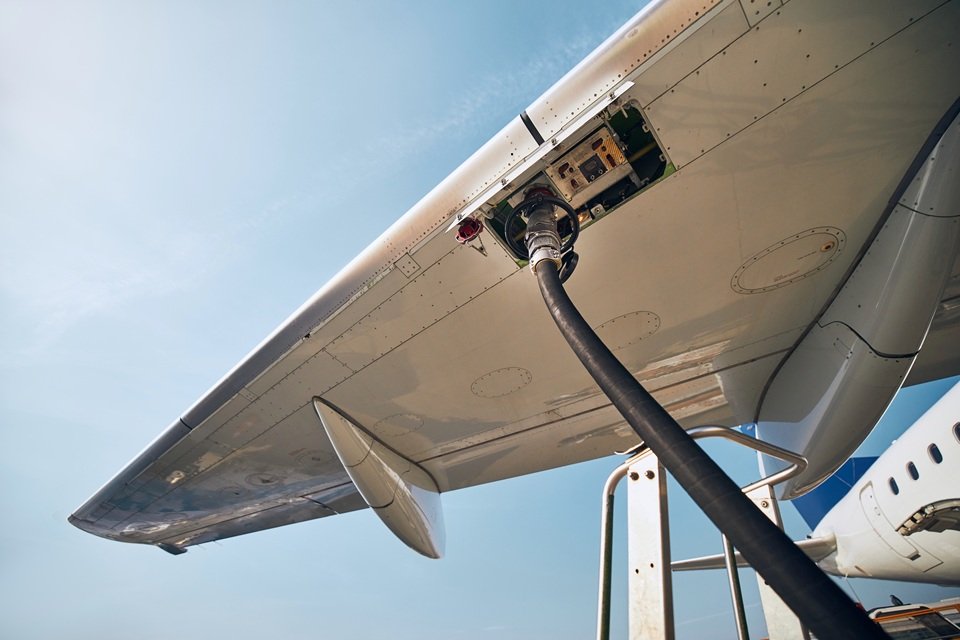
DHL said it has measures in place to protect its operations from jet fuel shortages, but still faces challenges at airports where it does not have a dedicated fuel supply setup.
Managing security of fuel supply is easier at DHL’s hubs compared to other locations, particularly in Asia, said Tobias Meyer, chief executive of DHL.
The company has hubs at airports including Leipzig/Halle (LEJ), Cincinnati/Northern Kentucky International (CVG), Hong Kong International (HKG) and Bahrain International (BAH).
Speaking about fuel availability during the company’s first quarter 2026 earning’s call, Meyer said: “I think we have to differentiate between large hubs or airports where we have our own base, where we have, you know, dedicated infrastructure, as the case in Leipzig, for fuel supply there.
“We have an intense dialogue, and we have more visibility and more certainty about that supply continuing and being sufficient to fully support our operations versus more spoke locations, especially in Asia, where we do not have such a setup and are very much dependent on the availability of fuel through the local supplier, that typically being a regulated market, and our choices being limited.”
He added: “We have seen in some Asian airports, constraints, either constraints that were announced, so no fuel, being available for additional flights, but also some structural shortages. We still then have the option to tanker in, so to fuel up at the, at the inbound flight, to a sufficient level that also supports the outbound flight.
“That is possible for regional and short-haul flights, not possible for intercontinental flights for obvious reasons. We had a couple of situation where that was the case.”
However, he added: “I think relative to other airlines, I see ourselves in a good position. I think we all recognise that if there’s a continued shortfall of 10, 12m barrels of crude every day, something has to give at some point.”
On jet fuel pricing, he pointed out that longer-term contracts are not as relevant.
“We pay generally the spot price. Even though we have longer-term contracts, that’s the usual way jet fuel supply works.”
Kuehne+Nagel (K+N) also recently reported that it is “well-positioned” to manage any potential jet fuel shortages as a result of the closure of the Strait of Hormuz.
Middle East stability
DHL has also positioned itself to withstand market volatility from the Middle East conflict.
The company said during its first quarter results release that its aircraft and airfreight ground infrastructure is “secured and operational”.
DHL explained that it had routed aircraft through King Khalid International (RUH) and Muscat International (MCT) to the Gulf area, while Tel Aviv is being served from the EU via its air and sea business and its road network is also connecting countries in the Gulf.
“In Express, our regional hub is in Bahrain, which was obviously significantly impacted by the military activities with airspace being closed for several weeks,” Meyer elaborated.
“We shifted operations using Riyadh and Muscat as primary airports of entry for our dedicated fleet, which we’re able to evacuate some aircraft out of Bahrain after some days into the conflict, and those then being productively deployed into Riyadh and Muscat.
“The network, road network that we have in the region was extremely helpful in this situation to connect via road Riyadh and Muscat to those areas, the UAE, Qatar, Bahrain, but also Kuwait where airspace was closed. That enabled us to provide good service to our customers.”
He pointed out that “not all competitors were able to provide such a setup”.
