


Burgeoning space launch provider Firefly Aerospace plans to debut an upgraded version of its flagship Alpha rocket as soon as this summer, CEO Jason Kim said Monday.
During the company’s first-quarter 2026 earnings call Kim revealed that Alpha’s more powerful Block II configuration is expected to handle the two-stage rocket’s next test flight. He said the company has completed qualification testing for that vehicle’s first- and second-stage engines. The company has not disclosed a customer for the test flight, which will be its eighth with Alpha.
Kim added that “structures and engines” for two additional Block II test flights, also planned for 2026, are heading into assembly.
Firefly has conducted seven test flights using Alpha’s original Block I configuration. Three were successful, while four suffered partial or complete failures.
Alpha’s second-stage engine was damaged during stage separation on April 2025’s “Message in a Booster” mission, preventing an experimental Lockheed Martin satellite from reaching orbit. It was the first of 25 missions that Lockheed purchased in 2024.
After the FAA grounded Alpha, the rocket bounced back in March with the “Stairway to Seven” mission, which carried another Lockheed demonstrator and validated some of the components that will be used on Block II.
Announced in January, the new configuration will upgrade the rocket’s avionics, batteries, and thermal protection while doubling its height from 100 to 200 feet.
“Block 2 is designed to expand Alpha’s deployable launch capabilities for critical responsive space missions, such as hypersonic testing, national security missions, and commercial satellite launches for domestic and international customers,” Kim said. “The significant improvements across Alpha from Block 2 focus on enhancing reliability and production rate.”
Kim said the company sees “strong interest” for Block II launches in 2027 and beyond. The U.S. Space Force has already shown interest in Alpha, which flew its first mission for the branch in 2023. The agency has since contracted Firefly for further missions.
Recently, Firefly signed an agreement with Seagate Space to explore an offshore launch platform for Alpha. Lockheed joined the effort on Monday.
What Else Is Next for Firefly?
Firefly’s Alpha is designed to deliver 2,200 pounds of payload to low-Earth orbit (LEO). It aims to offer a middle ground for satellites that are too large for light launchers, but too small to justify booking a larger vehicle, such as SpaceX’s Falcon 9. Germany’s Isar Aerospace and a handful of others are targeting that underserved segment.
Kim noted that “everything we learned from building, testing, and launching our Alpha rockets allows us to improve and reduce risk for Eclipse,” the company’s medium launch vehicle that he said is “marching towards its debut.”
Northrop Grumman is codeveloping the vehicle and has invested $50 million in Firefly. Eclipse is built using some components from Alpha, as well as Northrop’s Antares launch vehicle, and designed to launch close to 36,000 pounds to LEO—closer to Falcon 9’s payload of more than 50,000 pounds. Like Falcon 9, it is designed to be fully reusable, which would drive down launch costs.
Firefly in June predicted that Eclipse would debut this year. Kim said “all the major flight articles” for the medium-lift rocket, including its Miranda engines, are in the build and test phase. Earlier this year, the company completed qualification of the rocket’s liquid oxygen transfer line, pressure vessels, and the interstage that connects its two main stages.
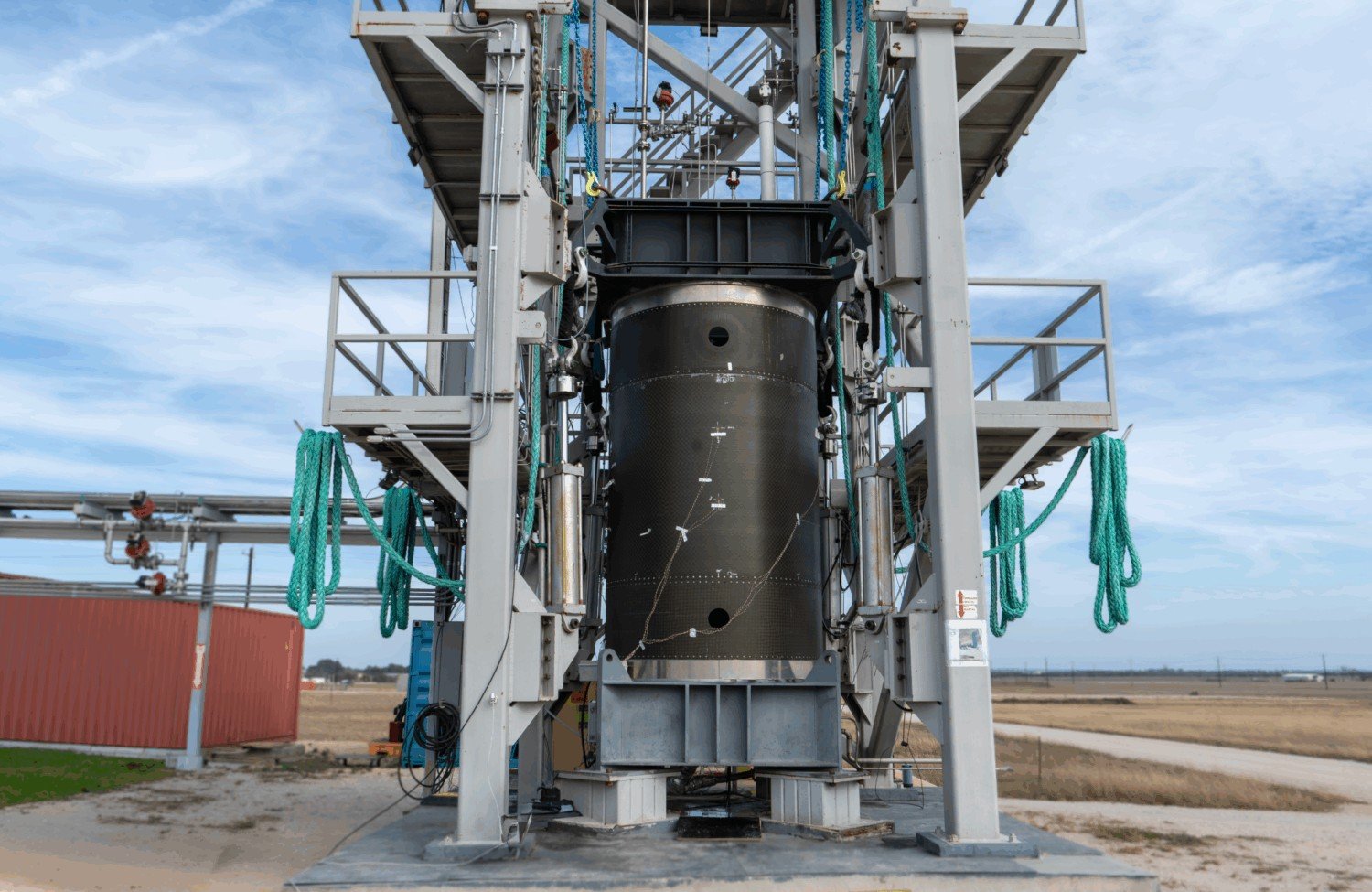
“More recently, we are progressing through the test campaign on Eclipse’s first-stage tanks, which tower nearly 100 feet tall,” Kim said. “This risk-reduction testing allows us to push the tanks beyond their limits to verify flight margins.”
Firefly builds more than just rockets. The company took home the 2025 Robert J. Collier Trophy for its Blue Ghost Mission 1, which saw it complete the first successful lunar landing by a commercial company.
Kim said the firm is developing lunar landers that dwarf the payload of its Blue Ghost. They could be large enough to meet NASA’s needs for future missions to the lunar surface as the space agency seeks to develop a permanent, $30 billion base.
