


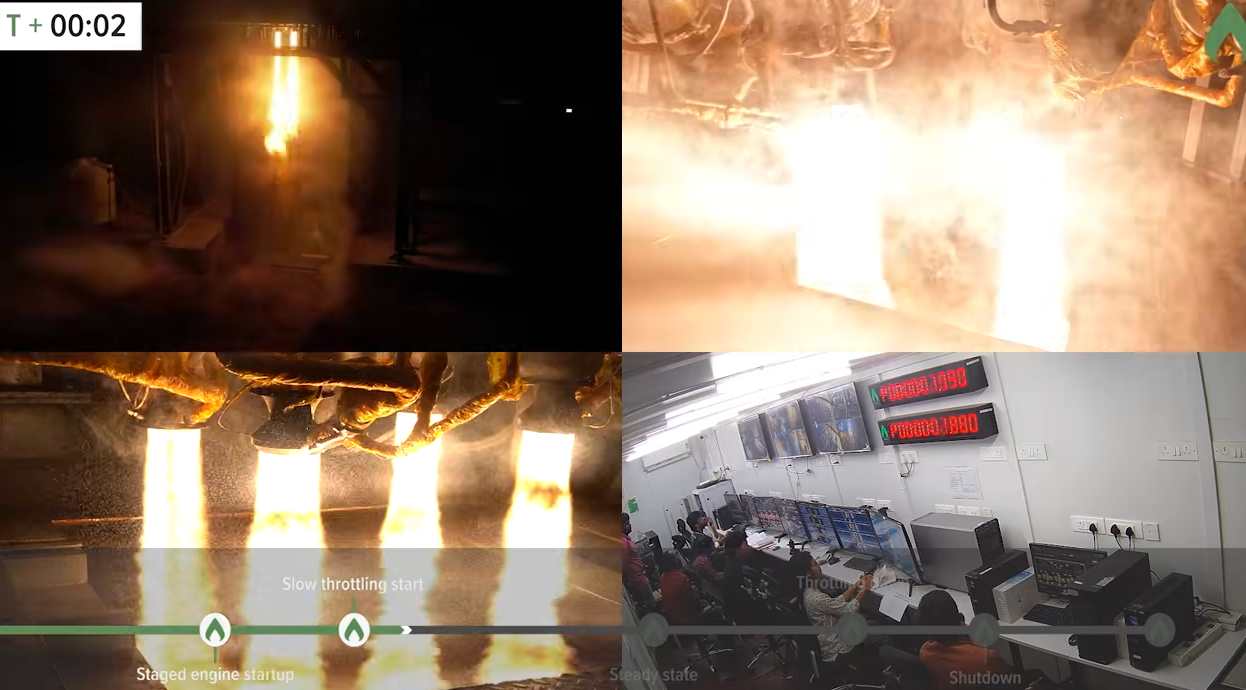
Agnikul Cosmos, the Chennai-based private launch startup, has reached another propulsion milestone: the simultaneous firing of four semi-cryogenic rocket engines, all of them 3D printed as individual, single-piece components and developed entirely in-house at the company’s Rocket Factory 1 facility. According to Agnikul, the test is the first of its kind in India involving semi-cryogenic engines in a cluster configuration.
Synchronizing Eight Systems at Once
What made this test technically demanding was not merely the number of engines involved, but the precision required to make them behave as one. The configuration called for eight pumps and eight electric motors, two per engine, each governed by its own independent speed control algorithm. All eight algorithms had to be tuned to act in concert across every phase: ignition, sustained operation, and shutdown.
“This test involved calibrating eight pumps, eight motors and tuning eight speed control algorithms to work together in perfect sync to achieve uniform startup, steady state and shutdown performance across the entire system,” said Srinath Ravichandran, Co-founder and CEO of Agnikul Cosmos.
The engines use an electric pump-fed architecture rather than conventional turbopumps, a design choice that gives Agnikul finer throttle control by varying motor speed, and, critically, reduces the component count that would otherwise need servicing or replacement between flights.
A Sequence of Firsts, Built in Months
The four-engine test did not emerge in isolation. It is the latest step in an accelerating cadence of propulsion milestones. In December 2025, Agnikul completed what it described as India’s first dual pump-fed engine firing, with two engines running in unison for 49 seconds. In March 2026, the company ran a full design-to-test cycle on the Agnite, a one-meter-long single-piece Inconel semi-cryogenic engine, at its Chennai test facility.
Each of these tests has followed the same manufacturing logic: engines printed in days, not months, designed and built entirely within Rocket Factory 1 without external tooling or fabrication partners. The approach is deliberate, Agnikul’s roadmap depends on production throughput matching customer demand, and conventional fabrication timelines would make that impossible.
The Quiet Revolution Against the Turbopump
Turbopumps have defined liquid rocket propulsion for decades, and their complexity along with it. Expensive to manufacture, difficult to throttle, and demanding to refurbish between flights, they are increasingly being challenged by a cleaner alternative: the electric pump-fed engine. Agnikul Cosmos’s latest test, clustering four such engines with eight synchronized control algorithms, pushes the architecture from a single-engine concept into a scalable flight system.
Rocket Lab’s Rutherford engine established the proof of concept: the world’s first 3D printed, electric pump-fed engine to reach orbit, now past 1,000 units produced across more than 70 Electron missions.
More recently, New Frontier Aerospace completed hot fire tests of its Mjölnir engine, a full-flow staged combustion design targeting a hypersonic VTOL platform in 2026 and an orbital transfer vehicle in 2027, signaling that electric pump architecture is expanding beyond small launch into higher-performance mission profiles.
What Agnikul is advancing is the next unsolved problem: cluster synchronization. If it holds at flight scale, Agnikul stands among a handful of launch companies to have validated clustered electric pump propulsion from scratch.
3D Printing Industry is inviting speakers for its 2026 Additive Manufacturing Applications (AMA) series, covering Energy, Healthcare, Automotive and Mobility, Aerospace, Space and Defense, and Software. Each online event focuses on real production deployments, qualification, and supply chain integration. Practitioners interested in contributing can complete the call for speakers form here.
To stay up to date with the latest 3D printing news, don’t forget to subscribe to the 3D Printing Industry newsletter or follow us on LinkedIn.
Explore the full Future of 3D Printing and Executive Survey series from 3D Printing Industry, featuring perspectives from CEOs, engineers, and industry leaders on the industrialization of additive manufacturing, 3D printing industry trends 2026, qualification, supply chains, and additive manufacturing industry analysis.
Featured image shows India’s First Four-Engine Cluster Firing. Photo via Agnikul Cosmos.
