


As Insta360 expands across cameras and drones, restrictions on DJI could create an opening for its increasingly direct Chinese competitor.
News and Commentary. DJI and Insta360 are neighbors as well as rivals in Shenzhen, China’s technology hub. Both have built global businesses around cameras and advanced imaging. Increasingly, they are also competing for the same customers.
This week offers a striking example.
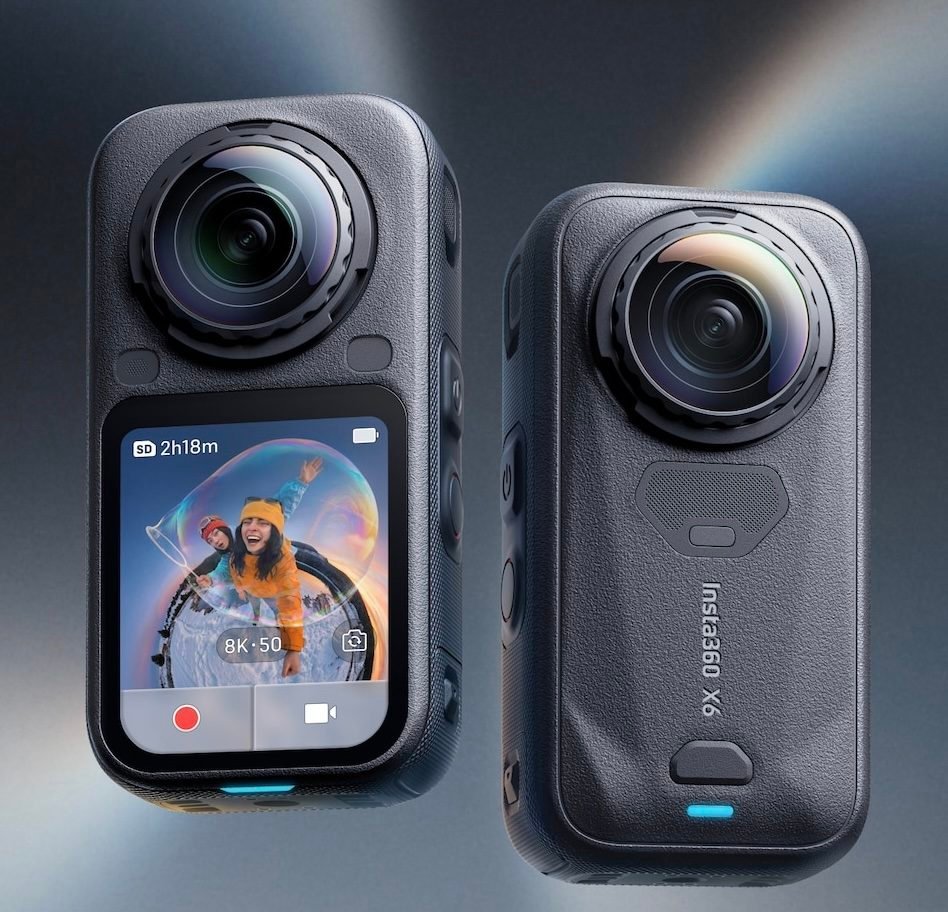
On August 12, Insta360 launched the X6, its latest flagship 360 camera, with U.S. availability starting at $699.99. One day later, DJI introduced the competing Osmo 360 II in China and Hong Kong. DJI has not announced U.S. availability for the new camera.
The contrasting launches highlight an unusual development in the U.S. technology market. DJI faces growing barriers to introducing new products in the United States. Insta360, another Chinese technology company based just across Shenzhen, continues to launch new products here.
That raises a broader question: Could restrictions on DJI be creating an opening in the U.S. market for one of its closest Chinese competitors?
Insta360 Launches the X6 in the U.S.
Insta360 describes the X6 as its most advanced 360 camera to date. The company says it currently holds 71% of the global panoramic camera market by value, citing IDC’s Worldwide Quarterly Handheld Smart Camera Tracker.
The X6 records native 8K video at up to 50 frames per second. Its dual Sony 1/1.1-inch square sensors provide what Insta360 describes as full 1-inch-equivalent 360 imaging. It also offers 10-bit color and native in-camera Dolby Vision.
The camera can operate in several ways. Users can capture a full 360-degree scene and choose the framing later. It can also produce flat 4K video while tracking a subject or operate as a conventional single-lens action camera.
Artificial intelligence plays a larger role in the new system. Insta360’s PanoMind can analyze footage on the camera and automatically create edited clips while the device charges. The company says that analysis takes place on the camera rather than in the cloud.
“X6 is the camera we always wanted to build. It captures everything around you, in any light, and hands you a finished edit before you even reach for your phone,” said JK Liu, founder of Insta360.
For U.S. buyers, one notable part of the launch is its availability. Insta360 is selling the X6 through its official store, Amazon and authorized U.S. retailers.
For DJI, bringing new products to the U.S. has become more complicated.
Two Companies Moving Into the Same Markets
DJI built its reputation in consumer drones, but its business has expanded far beyond aircraft. Its product lines include action cameras, 360 cameras, gimbal cameras, microphones, handheld stabilizers and other imaging products.
Insta360 has traveled in the opposite direction.
The Shenzhen company established its name in panoramic cameras before expanding into action cameras, gimbal cameras and a wider imaging ecosystem. It is also moving into drones through Antigravity, a brand Insta360 says it incubated in collaboration with third parties.
As their product portfolios converge, the competition has moved into the courts.
DJI and Insta360 filed patent infringement cases against each other in the U.S. District Court for the Eastern District of Texas earlier this year. Those U.S. cases were later withdrawn, but the dispute has continued in China.
In a March corporate filing, Insta360 parent Arashi Vision acknowledged a dispute over ownership of six patents before the Shenzhen Intermediate People’s Court. The patents involved employees who had previously worked for DJI. Insta360 disputed DJI’s position, saying available evidence indicated the inventions were independently developed after those employees joined Insta360.
The conflict expanded further this summer. Both companies confirmed in July that they had withdrawn their U.S. patent cases while pursuing claims in China. The disputes involve overlapping technologies in panoramic imaging, camera systems and stabilization. They also provide evidence of how closely the companies’ businesses are beginning to intersect.
Insta360 Moves Into Drones
That competition now extends into DJI’s original market.
Antigravity’s A1 combines a consumer drone with 360-degree imaging. Insta360 has described Antigravity as a brand it incubated, bringing its panoramic imaging experience into a new drone platform.
The A1 is also available to U.S. consumers. That makes the contrast between the two Shenzhen companies more complicated. Insta360 is not simply a camera manufacturer operating outside the drone industry. It has a direct connection to a consumer drone brand while continuing to introduce new imaging products in the United States.
Yet U.S. regulation treats the two companies differently.
Why DJI and Insta360 Face Different Rules
The difference is not simply that one company makes drones and the other makes cameras.
The FCC’s December 2025 Covered List action has two important elements. One covers foreign-produced UAS and UAS critical components, subject to specified exemptions. The other covers communications and video surveillance equipment and services identified under Section 1709(a)(1) of the FY2025 National Defense Authorization Act.
That law specifically names DJI and Autel Robotics, along with certain related entities.
As a result, DJI’s regulatory challenge extends beyond drones. In a March 2026 public notice, the FCC described DJI’s own petition for reconsideration as challenging an action that modified the Covered List “to include all of DJI’s communications and video surveillance equipment and services.”
Equipment on the Covered List cannot receive new FCC equipment authorizations. That can affect new DJI imaging products that fall within the covered categories and require FCC authorization, even when those products are not drones.
The distinction is important because Insta360 occupies a different regulatory position.
Although Insta360 is also based in Shenzhen and increasingly competes with DJI in cameras and other imaging products, it is not one of the manufacturers named in Section 1709(a)(1). Nor does the FCC’s broader restriction on foreign-produced drones automatically cover a general-purpose consumer camera.
FCC guidance says a UAS critical component must be designed and intended primarily for use in a drone. The agency specifically uses cameras to explain the distinction. According to the FCC, “a camera with many potential functions and uses that could theoretically be attached to a drone is not a UAS critical component.”
A camera designed primarily for use on a drone, by contrast, can fall within the definition.
That helps explain the different U.S. market positions of the two Shenzhen rivals. DJI faces a company-specific restriction covering communications and video surveillance equipment, in addition to the broader restrictions on foreign-produced UAS. Insta360 does not currently face that same company-specific restriction.
Could Insta360 Fill the Gap Left by DJI in the US?
There is no evidence yet that Insta360 has gained U.S. market share specifically because of DJI’s regulatory problems. But the potential opportunity is difficult to ignore.
DJI has developed strong brands in action cameras, gimbal cameras, microphones, 360 cameras and other creator products. Insta360 increasingly competes in many of those same categories.
If DJI cannot introduce some new imaging products normally in the United States, competing manufacturers have an opportunity to fill the resulting gap. Insta360 is especially noteworthy because it is not an American alternative to DJI. It is another Shenzhen technology company competing with DJI across an increasingly similar range of products.
The Unintended Consequences of US Policy
That creates a potential unintended consequence for U.S. policy. Federal policy has focused heavily on reducing dependence on foreign drone technology and addressing security concerns surrounding certain Chinese manufacturers. But restricting one Chinese company does not necessarily shift consumer demand toward U.S. manufacturers.
In adjacent imaging markets, some of that demand could instead move to another Chinese company.
That does not mean Insta360 is exploiting a loophole. The FCC has expressly distinguished general-purpose products from components designed primarily for drones. DJI also faces company-specific restrictions that do not currently apply to Insta360.
Instead, the situation illustrates the complexity of targeting specific technologies and manufacturers within a highly interconnected global electronics industry.
Antigravity Could Face a Different Test
Insta360’s expansion into drones could eventually put that distinction to the test.
The Antigravity A1 is currently available in the United States. But the regulatory environment for a future Antigravity aircraft is different from the one governing a general-purpose camera such as the X6.
The FCC’s Covered List includes foreign-produced UAS and UAS critical components. Existing equipment authorizations can remain valid, while new covered equipment generally cannot receive authorization unless an applicable exemption or approval applies.
That means Insta360’s ability to introduce new consumer cameras in the United States does not necessarily provide a path for future Antigravity drones.
For now, however, the contrast is striking.
As DJI encounters increasing obstacles in the U.S. market, Insta360 continues to expand. This week’s competing 360-camera launches provide a clear example.
Whether that translates into lasting U.S. market gains for Insta360 remains to be seen. But as the two Shenzhen rivals compete across a growing range of products, U.S. policy has become an increasingly important factor in determining where that competition can take place.
Read more:

Miriam McNabb is the Editor-in-Chief of DRONELIFE and CEO of JobForDrones, a professional drone services marketplace, and a fascinated observer of the emerging drone industry and the regulatory environment for drones. Miriam has penned over 3,000 articles focused on the commercial drone space and is an international speaker and recognized figure in the industry. Miriam has a degree from the University of Chicago and over 20 years of experience in high tech sales and marketing for new technologies.
For drone industry consulting or writing, Email Miriam.
TWITTER:@spaldingbarker
Subscribe to DroneLife here.
