


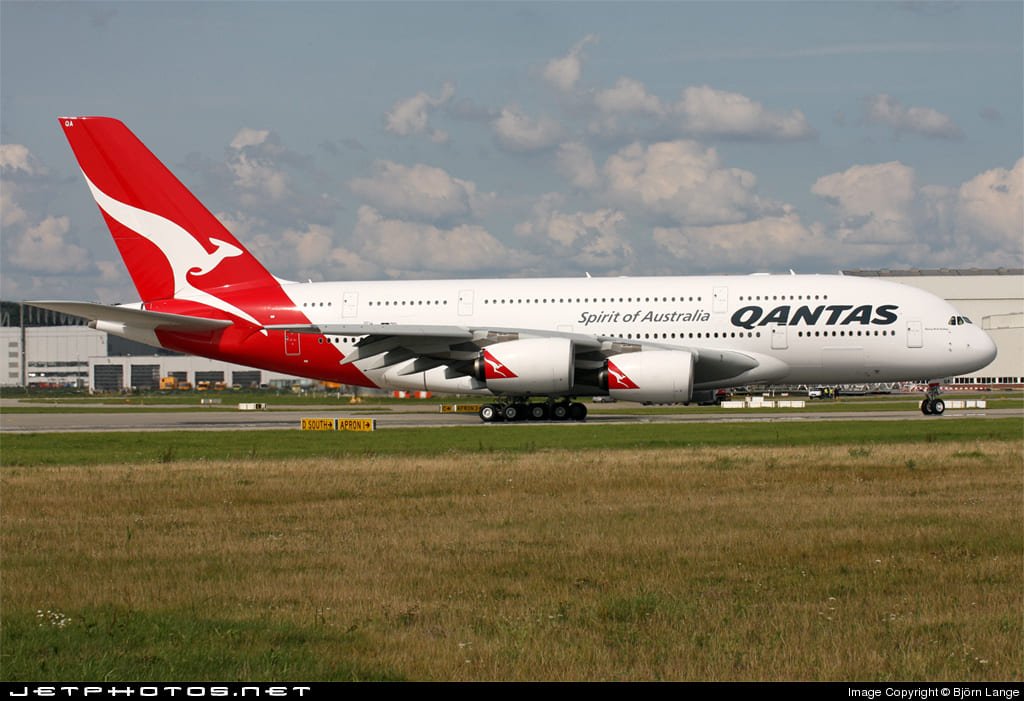
While presenting its financial results for August 2026, Qantas announced plans to accelerate the retirement of its iconic Airbus A380-800s, part of its fleet since September 2008. The original withdrawal plan for the A380s was set to be completed in 2032, but it will be brought forward by four years.
The main factors behind this decision were the conflict in the Middle East, which caused fuel costs to rise sharply and kept the price of aviation fuel highly volatile, and the inherent disadvantages of operating four-engine aircraft. This volatility had a direct negative impact of 420 million Australian dollars on the airline’s operating profit for its fiscal year. Furthermore, operating four-engine aircraft with an average age of 17 years became operationally unsustainable due to both surging fuel prices and an expensive supply chain, accelerating the transition toward new wide-body aircraft entering the fleet.
The end
Starting in March 2028, Qantas will begin phasing out its Airbus A380-800s, with the last scheduled flight of the “Super Jumbo” expected to take place by mid-year. Beyond operating costs and variables outside the airline’s control, Qantas has opted for an early retirement of the fleet now that it has full certainty regarding its delivery schedule, specifically for the new Airbus A350-1000ULRs slated for Project Sunrise.
Qantas holds firm orders for 36 wide-body aircraft, comprising 12 Airbus A350-1000ULRs, 12 standard Airbus A350s, four Boeing 787-9 Dreamliners, and eight Boeing 787-10 Dreamliners. Currently, the Qantas board of directors is in talks to exercise options for an additional 20 wide-body aircraft, split equally between Airbus and Boeing.

The beginnings
This story began nearly 26 years ago, more precisely on November 29th, 2000. The Australian airline had announced the addition to its fleet of Airbus’s new project, known today as the Airbus A380—the Airbus A3XX. It was a historic decision for Qantas, which at that time operated a long-haul fleet consisting exclusively of Boeing 747-400 aircraft.
A month later, Qantas signed the contract, formalizing the purchase of 12 aircraft and becoming the first international customer to sign a binding agreement with Airbus for this model. The airline operated 12 Airbus A380s until just before the pandemic, having previously ordered eight additional units, which were ultimately canceled in 2019.

The first A380
On January 25th, 2008, the Airbus A380-842 with serial number 014 made its maiden flight. Manufactured in Toulouse and initially assigned the French test registration F-WWSK, the aircraft departed for Sydney nine months later. Bearing the Australian registration VH-OQA, it became the first Airbus A380 to join a oneworld member airline.
The aircraft arrived at Sydney’s Kingsford Smith Airport on the afternoon of September 21st, coming from Toulouse via Singapore. Following its arrival, the “Nancy-Bird Walton” was welcomed by government authorities, the airline’s executives, the press, and guests. It entered regular service on October 20th, 2008, on the Melbourne–Los Angeles route.

Qantas concluded 2008 with three Airbus A380-800s in its fleet, after completing the delivery of the aircraft registered as VH-OQB and VH-OQC.The airline expanded its fleet in 2009 with two additional aircraft (VH-OQD and VH-OQE), followed by another pair in 2010 (VH-OQF and VH-OQG). The initial order of 12 Super Jumbos was completed in 2011, when VH-OQH, VH-OQI, VH-OJJ, VH-OQK, and VH-OQL officially joined the fleet.
As a result of the COVID-19 pandemic, the airline temporarily grounded its entire Airbus A380s fleet, gradually resuming operations as of 2022. Two aircraft (VH-OQE and VH-OQF) were permanently retired from service in March 2020 and ferried to Victorville in June and July 2020, respectively. Both are currently partially scrapped.

Present
At the time of publication, Qantas has nine operational Airbus A380-800s, with the VH-OQJ aircraft temporarily grounded. All of its A380s are configured for 485 passengers in four classes (14 seats in First, 70 in Business, 60 in Premium Economy, and 341 in Economy). The two retired aircraft had a capacity of 484 passengers (14 seats in First, 64 in Business, 35 in Premium Economy, and 371 in Economy).
Qantas’ A380
| Registration | Config | Delivered | Aircraft name |
|---|---|---|---|
| VH-OQA | F14C70W60Y341 | September 2008 | Nancy-Bird Walton |
| VH-OQB | F14C70W60Y341 | December 2008 | Hudson Fysh |
| VH-OQC | F14C70W60Y341 | December 2008 | Paul McGinness |
| VH-OQD | F14C70W60Y341 | August 2009 | Fergus McMaster |
| VH-OQE | Retired | December 2009 | Lawrence Hargrave |
| VH-OQF | Retired | January 2010 | Charles Kingsford Smith |
| VH-OQG | F14C70W60Y341 | December 2010 | Charles Ulm |
| VH-OQH | F14C70W60Y341 | January 2011 | Reginald Ansett |
| VH-OQI | F14C70W60Y341 | January 2011 | David Warren |
| VH-OQJ | F14C70W60Y341 | April 2011 | Bert Hinkler |
| VH-OQK | F14C70W60Y341 | November 2011 | John Dulgan / Reginald Dulgan |
| VH-OQL | F14C70W60Y341 | December 2011 | Phyllis Arnott |
| VH-OQM | Not built | – | Keith and Ross Smith |
| VH-OQN | Not built | – | Lester Brain |
For several years, Qantas has based its entire Airbus A380-800 fleet at Sydney’s Kingsford Smith Airport, deploying them on key long-haul corridors to Africa, Asia, North America, and Europe via Singapore. The United States remains its primary market in terms of weekly frequencies and capacity, followed by high-demand routes to Singapore, the United Kingdom, and South Africa.
Qantas’ A380 routes

| Country | Destination | Flight(s) | Seats |
|---|---|---|---|
| Singapore | Singapore (SIN) | 7 weekly | 3,395 weekly* |
| South Africa | Johannesburg (JNB) | 4 weekly | 1,940 weekly |
| United Kingdom | London (LHR) | 7 weekly | 3,395 weekly* |
| United States | Dallas (DFW) | 7 weekly | 3,395 weekly |
| United States | Los Angeles (LAX) | 6 weekly | 2,910 weekly |
*Qantas operates the Sydney – Singapore – London Heathrow route and vice versa with a daily frequency. The airline has traffic rights on all segments (SYD-SIN, SYD-LHR, SIN-LHR, LHR-SIN, LHR-SYD and SIN-SYD).
A historic flight
As we reported in another post, Qantas operated an unprecedented flight this year with one of its Airbus A380s.
On February 23rd, the Airbus A380-842 with registration number VH-OQA departed from São Paulo’s Guarulhos Airport in Brazil bound for Sydney, operating flight QF308. Initially, the schedule included a technical stop in Auckland, but the flight from São Paulo to Sydney was finally operated nonstop.
Puerto Rican singer Bad Bunny chartered this Qantas Airbus A380 to transport his crew from Brazil to Australia, as the South American leg of his “DeBÍ TiRAR MáS FOToS” world tour transitioned toward Oceania. This operation marked the first-ever nonstop flight between the two countries, as well as an unprecedented, one-off direct charter connecting São Paulo and Sydney. For more information about this flight and operations in the Oceania–Latin America market, you can check out this post.

Cover photo: © Morris Biondi – JetPhotos (Sydney, Australia)
The post Qantas’ A380s set for an early retirement — again appeared first on Flightradar24 Blog.
