


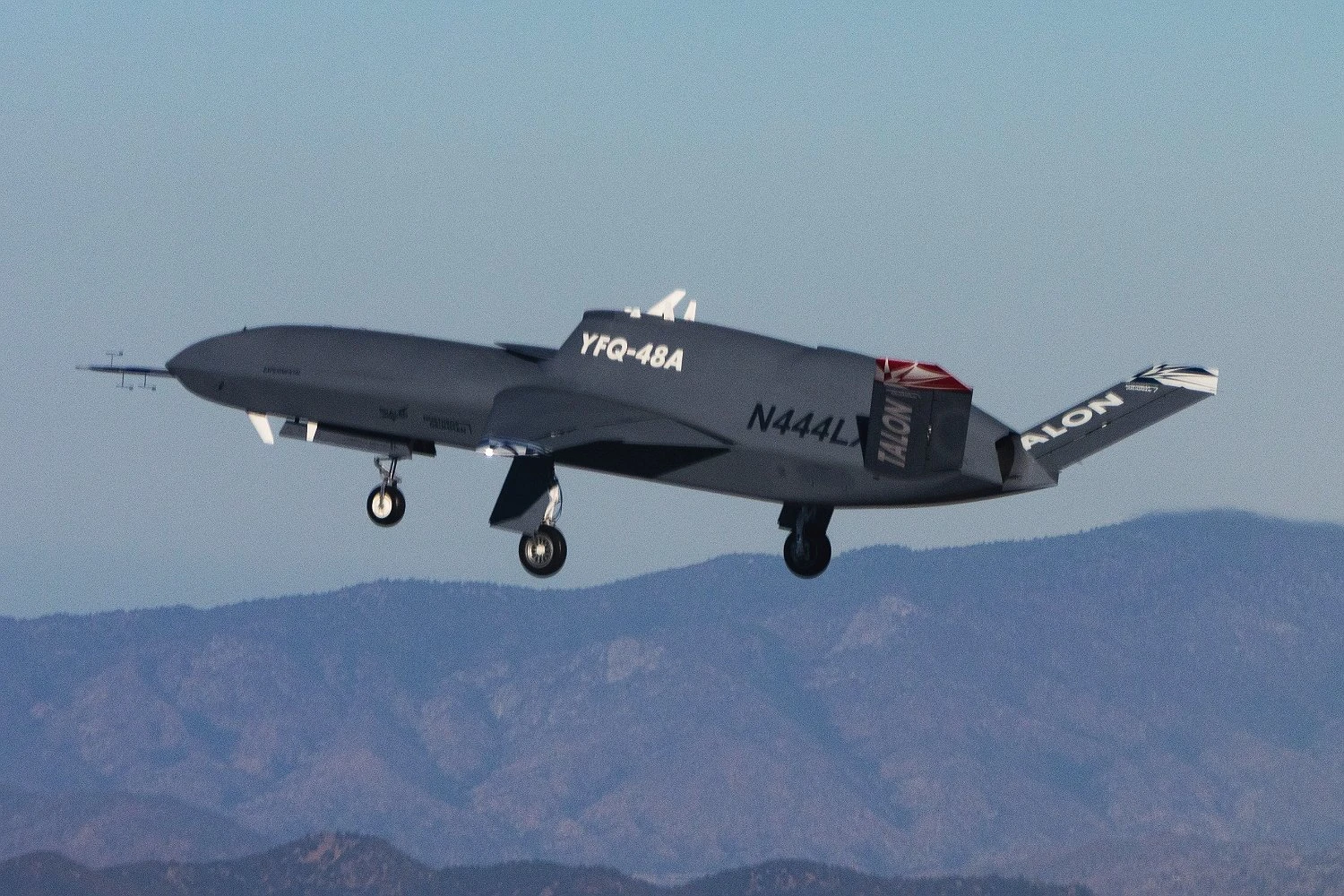
The Royal Navy plans to launch Northrop Grumman’s YFQ-48A Talon Blue autonomous combat jet from the aircraft carrier HMS Prince of Wales in 2027, marking a new step in Britain’s efforts to introduce uncrewed combat aircraft alongside its F-35B fighters.
The plan was announced on November 10 by General Sir Gwyn Jenkins, the UK’s First Sea Lord, during the International Sea Power Conference in Oslo, Norway. Jenkins said the Navy intended to demonstrate the operation of the American-built aircraft from one of its Queen Elizabeth-class carriers.
The announcement is part of Project Vanquish, which is exploring how autonomous combat aircraft could operate from British carriers. Jenkins also revealed plans to sign a statement of intent with Northrop Grumman on November 12 to support the demonstration.
The proposed trial would involve launching the Talon Blue from HMS Prince of Wales. However, the Navy has not confirmed whether the aircraft will also land aboard the carrier, an important distinction given the ship’s configuration and the drone’s conventional design.
New American combat drone
The Talon Blue is a jet-powered autonomous aircraft developed by Northrop Grumman as a potential Collaborative Combat Aircraft (CCA), a category of uncrewed aircraft designed to operate alongside crewed fighters.
The aircraft made its first flight on October 3, 2026, in California. According to the manufacturer, it completed taxiing, takeoff, flight maneuvers and landing autonomously during its initial test campaign.
Follow Air Data News: WhatsApp | Instagram | LinkedIn | Twitter | Facebook
Northrop Grumman developed the demonstrator with its own funding. The aircraft has not received a production order from the US Air Force, which is pursuing other designs under the first phase of its CCA program.
The British demonstration would give the Talon Blue an additional role as a test platform for naval operations, an environment that presents different challenges from conventional land-based airfields.

Carrier operations pose a major challenge
The Royal Navy operates two Queen Elizabeth-class aircraft carriers, HMS Queen Elizabeth and HMS Prince of Wales. Both were designed primarily around the F-35B Lightning II, which can take off over a short distance and land vertically.
Unlike American carriers equipped with catapults and arresting gear, the British ships use a ski-jump ramp to assist aircraft during takeoff. They do not have the conventional recovery equipment used to stop jets landing at high speed.
The Talon Blue is a conventional jet aircraft, rather than a short takeoff and vertical landing design like the F-35B. This raises questions about how it could be launched from the carrier and, particularly, how it might be recovered after a mission.
The Navy has not disclosed whether the aircraft will require structural modifications, a specialized launch system or a separate recovery arrangement. A demonstration limited to takeoff would avoid the most difficult part of returning a conventional jet to the carrier.
Britain has already experimented with uncrewed aircraft aboard its carriers. In 2023, HMS Prince of Wales conducted trials with the General Atomics Mojave, a propeller-driven drone designed for short takeoff and landing operations.

The Royal Navy has also tested other uncrewed systems, including the Tekever AR5, as it investigates ways to expand surveillance and operational capabilities without relying exclusively on crewed aircraft.
The Talon Blue would represent a different category of aircraft, combining jet propulsion with autonomous flight capabilities and a design intended for future combat missions.
For the Royal Navy, the longer-term objective is to explore how such aircraft could complement its F-35B fleet. The planned 2027 demonstration is an initial technical trial, rather than confirmation that the Talon Blue will enter British service or become operational aboard its carriers.
See also: carrier drone trials and collaborative combat aircraft developments.
